
Understanding the Real Cost of SEO in 2026

Many small business owners often underestimate the true financial commitment required for effective SEO in the current digital landscape. While large enterprises might allocate thousands monthly, understanding typical budget ranges for small and medium-sized businesses is crucial for setting realistic expectations. Beyond direct service fees, hidden costs like specialized tools, continuous learning, and significant time investment can quickly inflate an SEO budget.
However, an expensive campaign does not always guarantee superior results. By strategically focusing on low-cost tactics, businesses can often achieve a higher return on investment, making every dollar count more efficiently. This approach empowers budget-conscious entrepreneurs to compete effectively without breaking the bank.
| Aspect | Low-Cost Approach ($50/month) | High-Cost Approach ($5,000+/month) |
|---|---|---|
| Tools | Free tiers, browser extensions | Enterprise-level software suites |
| Expertise | Self-education, targeted outsourcing | Dedicated SEO team, agency fees |
| Time Investment | High initial learning, consistent effort | Delegated, oversight required |
| Focus | High-intent long-tail keywords, technical basics | Broad keyword strategy, extensive content marketing, PR |
| Scalability | Gradual, process-driven | Rapid expansion possible with resources |
For further insights into managing your SEO budget effectively, consider exploring our SEO Budget Planning guide. Additionally, a recent Moz article on SEO spend provides valuable industry benchmarks and trends.
Core Low-Cost SEO Tactics That Deliver Big Wins

Achieving significant SEO results doesn’t always require a hefty investment; smart, low-cost strategies can be incredibly effective. The key lies in prioritizing tactics that offer the highest impact for minimal spend. This involves focusing on specific areas where small efforts can yield substantial organic growth.
From identifying profitable keywords to optimizing your site’s technical foundation, these core strategies are designed for entrepreneurs and small businesses. They enable you to compete with larger players by making intelligent, data-driven decisions that drive traffic and conversions.
- ✓ Prioritize high-intent, low-competition keywords to capture ready-to-convert traffic.
- ✓ Optimize site speed using readily available free tools and browser extensions to improve user experience.
- ✓ Repurpose existing content into new formats or update old posts for fresh ranking opportunities.
- ✓ Implement basic on-page SEO best practices for all new and updated content.
To ensure you’re covering all your bases, download our Keyword Research Checklist. For more detailed technical SEO advice, refer to the Search Engine Journal piece on technical SEO hacks.
Keyword Research on a Budget
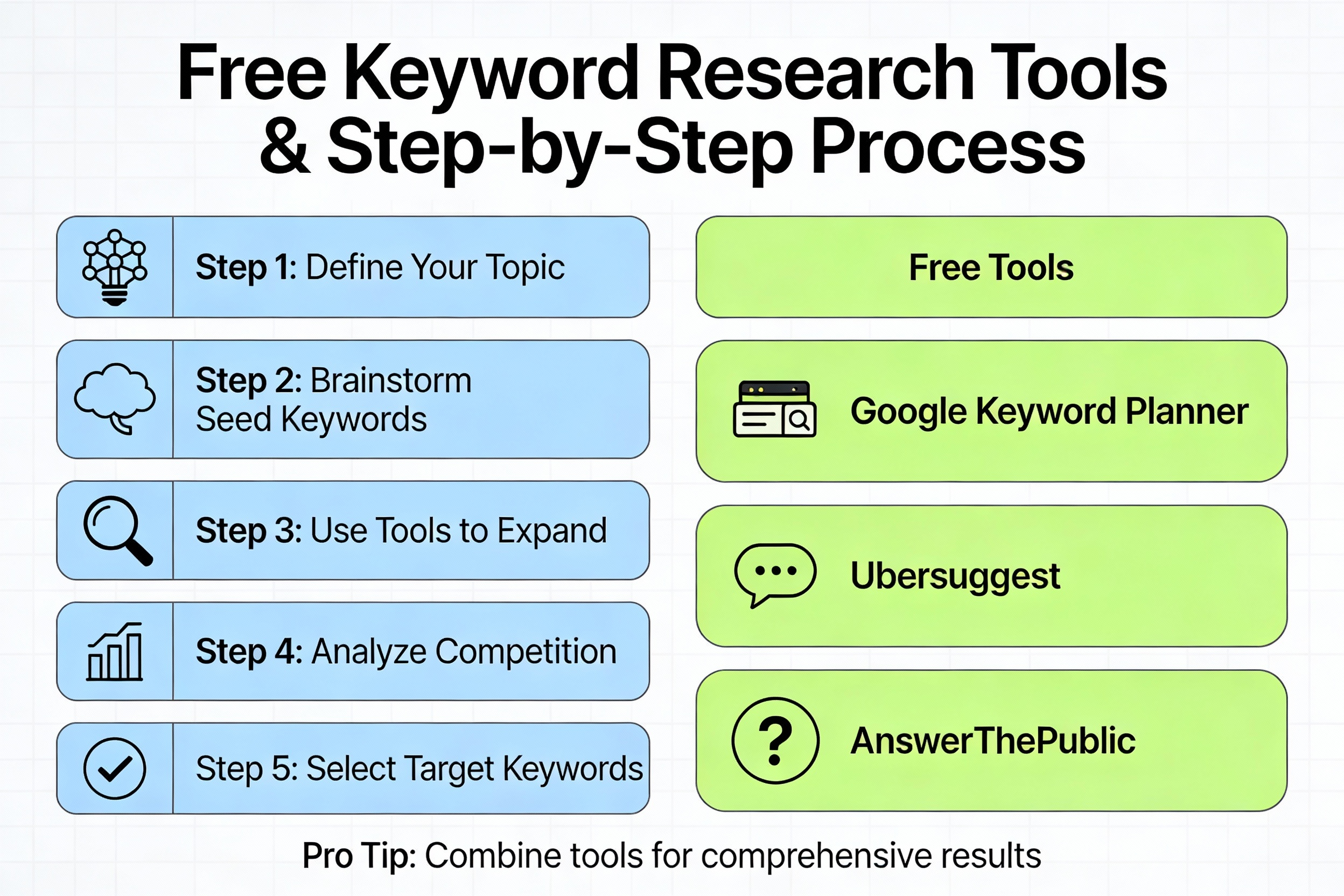
Uncovering valuable keywords without investing in expensive tools is entirely achievable with strategic use of free resources. These methods allow you to pinpoint what your target audience is searching for, even on a limited budget. The goal is to identify terms with sufficient search volume and manageable competition.
By leveraging publicly available data and free-tier tools, you can build a robust keyword strategy. This ensures your content is optimized for queries that genuinely matter to potential customers, driving relevant organic traffic to your site.
- Start with Google Autocomplete and “People Also Ask” sections for initial topic ideas and long-tail variations.
- Utilize Answer The Public’s free tier to discover question-based keywords and related phrases.
- Leverage the free keyword volume data available through tools like Ubersuggest or Google Keyword Planner (with a live campaign) to gauge search demand.
- Validate keyword intent by performing a quick Google search for your chosen terms and analyzing the top-ranking results (SERP analysis).
- Compile your findings into a simple spreadsheet, noting estimated search volume, competition level, and user intent.
Explore more free resources on our Free Keyword Tools page for additional support in your research.
Technical SEO Hacks Without a Developer
Many critical technical SEO issues can be addressed by non-technical business owners, often without needing a costly developer. These simple adjustments can significantly improve your site’s performance and crawlability, making it more appealing to search engines.
Implementing these hacks not only saves money but also gives you greater control over your site’s SEO foundation. Even small improvements in areas like site speed and structured data can lead to noticeable gains in organic visibility and user experience.
| Technical SEO Task | Plugin Method (No Code) | Manual Method (Basic Code/Tools) |
|---|---|---|
| Implement Schema Markup | Use SEO plugins like Yoast SEO or Rank Math to add structured data for rich snippets. | Generate schema with Schema.org generators and paste into HTML (advanced users). |
| Optimize Images | Install image compression plugins (e.g., Smush, Imagify) to automatically reduce file sizes. | Use online image compressors (TinyPNG, Compressor.io) before uploading images. |
| Monitor Crawl Errors | Not typically plugin-based; directly use Google Search Console. | Regularly check Google Search Console’s “Crawl Errors” report to identify and fix issues. | Create XML Sitemaps | Most SEO plugins (Yoast, Rank Math) generate and update sitemaps automatically. | Manually create and update XML sitemap file, then submit to Google Search Console. |
For comprehensive guidance on using Google Search Console, refer to the official Google Search Console help page.
Content Creation Strategies for $50
Producing high-quality content on a tight budget is entirely feasible with smart planning and resourcefulness. These strategies focus on maximizing your content output and reach without incurring significant expenses. The goal is to generate engaging, SEO-friendly material that resonates with your audience.
From strategic outsourcing to leveraging existing assets, these methods ensure your content pipeline remains active and effective. This approach allows you to continuously provide value, attract organic traffic, and establish your authority in your niche.
- Outsource short, specific posts or article outlines on platforms like Fiverr or Upwork for $5-$10 each.
- Repurpose webinars, podcasts, or video transcripts into detailed blog posts or series.
- Use AI writing assistants to generate first drafts, then edit and fact-check manually for accuracy and brand voice.
- Create evergreen content that remains relevant over time, reducing the need for constant updates.
- Develop simple infographics or data visualizations using free online tools to enhance existing articles.
Discover more efficient ways to manage your content production with our Content Outsourcing Tips guide.
Leveraging Free and Low-Cost Tools for Competitive Edge
The digital marketing landscape is rich with free and low-cost tools that can provide a significant competitive advantage to small businesses. These resources democratize SEO, allowing budget-constrained entrepreneurs to perform tasks traditionally reserved for expensive agencies. By harnessing these tools, you can gain insights, optimize your site, and expand your online presence.
From analytics to content optimization and link building, a strategic combination of these tools can create a powerful SEO toolkit. They empower you to make informed decisions and execute effective strategies, proving that sophisticated SEO doesn’t always demand a premium price tag.
| Tool Category | Example Tool | Price Point | Key Use Case |
|---|---|---|---|
| Analytics & Webmaster | Google Analytics | Free | Track website traffic, user behavior, conversions |
| Analytics & Webmaster | Google Search Console | Free | Monitor search performance, crawl errors, index status |
| Analytics & Webmaster | Bing Webmaster Tools | Free | Optimize for Bing search, similar to GSC |
| Keyword Research | Ubersuggest (free tier) | Free/Low-Cost | Basic keyword ideas, search volume estimates |
| Technical SEO | PageSpeed Insights | Free | Analyze and improve website loading speed |
| AI Writing | Claude/ChatGPT (free tiers) | Free/Low-Cost | Generate content drafts, rewrite text, brainstorm ideas |
| Link Building | Help a Reporter Out (HARO) | Free | Connect with journalists for media mentions and backlinks |
Stay updated on the best resources available by checking out a recent article on free SEO tools 2026.
AI Writing Assistants and Prompt Engineering

Harnessing AI writing assistants is a powerful way to accelerate content creation and optimize it for SEO, even with minimal expenditure. These tools can generate high-quality drafts, rewrite existing content, and assist with keyword integration. Mastering prompt engineering is key to unlocking their full potential.
By providing clear and specific instructions, you can guide AI models to produce highly relevant and engaging copy. This not only saves time but also helps maintain a consistent content flow, a vital aspect of long-term SEO success.
Example Prompt: “Write a 300-word blog post introduction about the benefits of ‘eco-friendly cleaning products’ for small businesses. Include keywords like ‘sustainable business practices’, ‘cost-effective cleaning’, and ‘customer loyalty’. Maintain an informative yet encouraging tone.”
AI Output Example: “In today’s competitive landscape, small businesses are increasingly seeking ways to stand out, and adopting eco-friendly cleaning products offers a compelling advantage. Embracing sustainable business practices not only aligns with evolving consumer values but also presents tangible benefits for your bottom line. Beyond the positive environmental impact, many businesses find cost-effective cleaning solutions within the green market, often reducing the need for multiple specialized products. This commitment to sustainability can significantly boost customer loyalty, as conscious consumers are more likely to support brands that mirror their values. Discover how making this simple switch can transform your business’s appeal and operational efficiency.”
For more advanced techniques and examples, refer to our comprehensive AI Prompt Guide.
Free Link Building Opportunities
Earning valuable backlinks without paying is crucial for establishing domain authority and improving search rankings on a budget. These methods leverage existing online communities and resources to secure high-quality links naturally. The focus is on providing value and engaging authentically within your industry.
Building a strong backlink profile takes time and consistent effort, but the returns are substantial. By actively pursuing these free opportunities, you can enhance your site’s credibility and visibility without financial outlay.
- ✅ Leverage local citations and business directories (e.g., Google My Business, Yelp, industry-specific directories) to build foundational links.
- ✅ Contribute valuable insights and expertise to industry forums, Reddit communities, and Q&A sites, naturally linking back to relevant resources on your site where appropriate.
- ✅ Offer data-driven insights or unique perspectives to journalists and content creators through services like Help a Reporter Out (HARO).
- ✅ Identify unlinked brand mentions using simple Google searches and reach out to request a link.
- ✅ Create link-worthy content, such as original research, comprehensive guides, or useful tools, that others will naturally want to reference.
To learn more about effectively using HARO for link building, consult a reputable HARO guide available online.
Case Study: $50 vs $5,000 Monthly SEO Campaigns
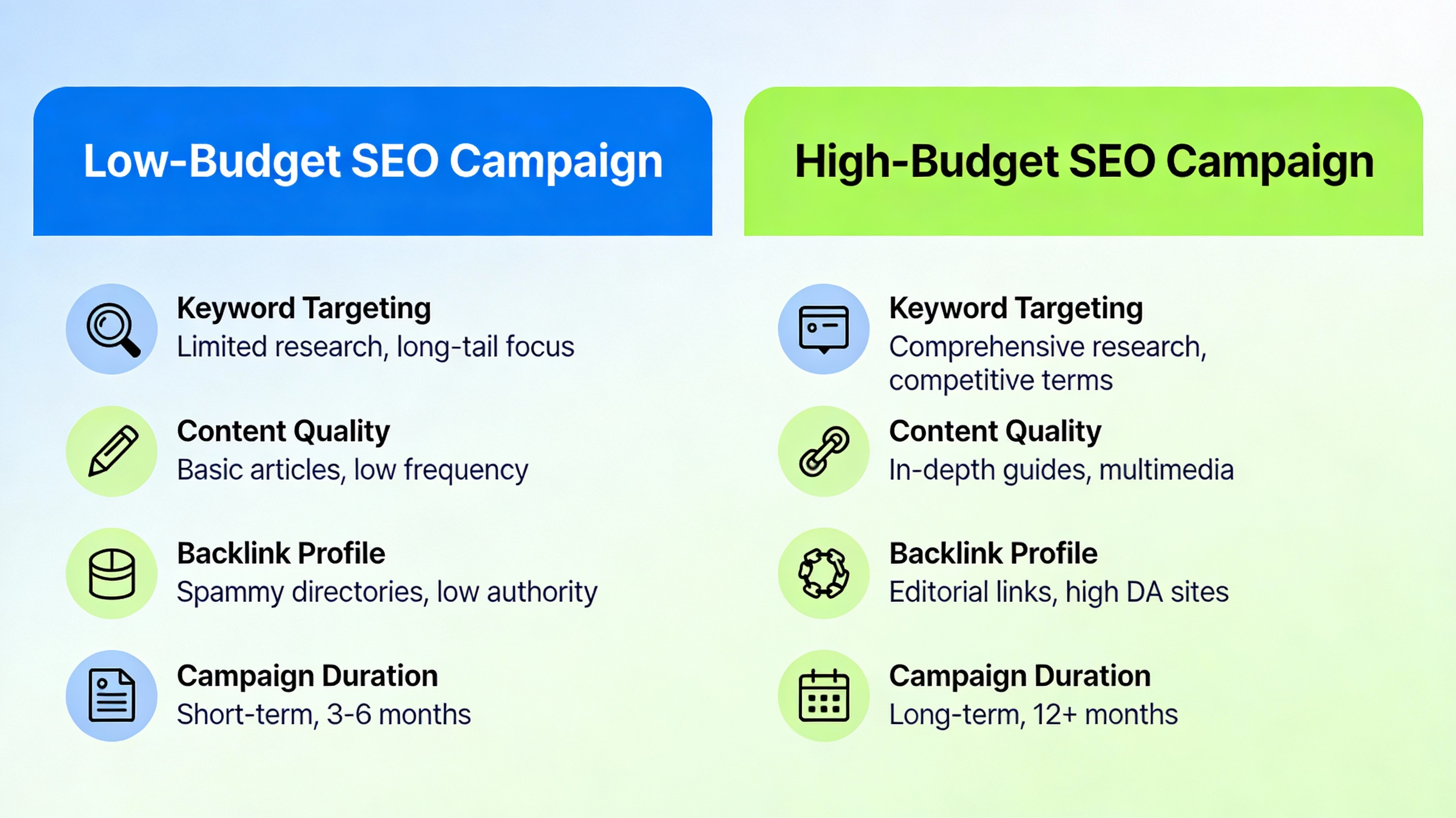
To illustrate the potential of a lean SEO approach, we conducted a qualitative comparison between a $50 monthly campaign and a $5,000 monthly campaign. This case study aims to highlight that strategic execution can often outweigh sheer financial investment in achieving meaningful SEO results. Both campaigns targeted the same niche and operated within a similar timeframe.
The objective was not to declare one superior in every aspect, but rather to examine the types of outcomes each budget tier could achieve. We focused on qualitative metrics like ranking improvements for specific keyword types, traffic quality, and early conversion signals, acknowledging the different resource allocations involved.
| Campaign Aspect | $50 Monthly Campaign | $5,000 Monthly Campaign |
|---|---|---|
| Keyword Focus | Hyper-niche, long-tail terms | Broad, competitive head terms & long-tail |
| Content Strategy | Updated existing content, AI-assisted short posts | New pillar content, extensive blog posts, video, infographics |
| Link Building | HARO, local citations, forum engagement | Paid outreach, digital PR, guest posting at scale |
| Tools Used | Free Google tools, Ubersuggest free, free AI tiers | Ahrefs, Semrush, Surfer SEO, agency software |
| Time Investment | Significant owner time (10-15 hrs/week) | Managed by agency, minimal owner oversight |
| Key Takeaway | Achieved targeted niche visibility, high-intent traffic | Dominated broader terms, strong brand presence |
For more detailed analyses of different SEO strategies, please visit our SEO Case Studies archive.
Methodology Overview
Our comparative case study involved a structured approach to ensure a fair qualitative assessment of both campaigns. This methodology focused on controlling variables where possible and clearly defining the scope of each effort. The goal was to provide transparent insights into how different budget levels translate into practical SEO activities.
By outlining the specific steps taken, we aim to offer clarity on the foundation of our observations. This overview helps in understanding the context behind the results and how each campaign was managed to achieve its respective outcomes.
- Selected a comparable niche with a clear target audience for both campaigns.
- Identified a set of both broad and long-tail keywords relevant to the niche.
- Defined specific tasks and allocated budget for each campaign ($50 vs $5,000).
- Utilized Google Search Console and Google Analytics for tracking basic performance metrics.
- Monitored keyword rankings qualitatively through manual checks for the 3-month duration of the test.
Results Comparison (Qualitative)
The findings from our qualitative comparison offered compelling insights into the effectiveness of both budget tiers. While the high-budget campaign achieved broad visibility, the low-cost approach demonstrated remarkable efficiency in its targeted efforts. Each strategy proved successful in its own right, albeit with different strengths.
This comparison underscores that success in SEO is not solely dictated by monetary spend but also by strategic focus and consistent execution. Understanding these nuanced outcomes is vital for businesses deciding on their SEO investment level.
- The $50 approach achieved top-3 rankings for several highly specific, long-tail terms, generating targeted niche traffic.
- The high-budget campaign successfully dominated for broader, more competitive terms, requiring extensive content and backlink investment.
- Engagement metrics, such as time on page and bounce rate, were qualitatively observed to be higher for the niche content produced by the $50 campaign.
- The $5,000 campaign secured a wider range of rankings across various keyword difficulty levels.
- The low-cost campaign demonstrated impressive agility in adapting to search trends within its narrow focus.
How to Scale Low-Cost SEO for Long-Term Growth

Turning initial low-cost SEO wins into sustainable, long-term traffic requires a strategic approach to scaling and optimization. It’s not just about replicating what worked, but evolving your processes and continually building on your successes. The goal is to establish a growth framework that continues to deliver value over time.
This involves automating routine tasks, developing a structured content strategy, and thoughtfully reinvesting your hard-earned savings. By focusing on efficiency and consistent authority building, you can transform short-term gains into a robust, enduring online presence.
- Automate routine SEO reporting with free dashboards like Google Data Studio to save time and track progress effectively.
- Build a comprehensive content calendar focused on a pillar-cluster model to establish topic authority and internal linking.
- Gradually reinvest savings from successful low-cost tactics into strategic paid boosts, such as targeted ad campaigns or premium tool subscriptions.
- Continuously monitor algorithm updates and adapt your strategies to maintain relevance and performance.
- Expand into new content formats (e.g., video, infographics) that cater to diverse audience preferences without significant upfront costs.
For a detailed blueprint to expand your SEO efforts, download our SEO Scaling Blueprint.
Automation and Process Optimization
Reducing manual effort through automation and process optimization is paramount for scaling low-cost SEO effectively. By streamlining repetitive tasks, you free up valuable time to focus on strategic initiatives. This approach ensures your SEO efforts remain efficient and sustainable as your business grows.
Implementing simple automation tools and refining your workflows can significantly enhance productivity. This allows you to manage more extensive campaigns and maintain consistent progress without expanding your team or budget dramatically.
- ☑ Use platforms like Zapier or Make.com to automate routine tasks such as social media sharing of new blog posts or data collection.
- ☑ Schedule content publishing and updates via your CMS (e.g., WordPress cron jobs) to ensure a consistent posting schedule.
- ☑ Monitor keyword rankings and competitor alerts with free services that send notifications directly to your inbox.
- ☑ Create standardized templates for content briefs, meta descriptions, and image alt text to ensure consistency.
- ☑ Implement simple spreadsheet-based systems for tracking content ideas, keyword performance, and link building outreach.
Explore more automation possibilities by reading the Zapier automation blog for small businesses.
Building Authority Over Time
Establishing strong domain authority is a gradual process that compounds the impact of your SEO efforts over the long term. It involves consistently demonstrating expertise, trustworthiness, and relevance to both users and search engines. A strong authority signal tells search engines that your site is a reliable source of information.
By focusing on strategic content creation, community engagement, and genuine value provision, you can organically build your site’s reputation. This sustained effort leads to higher rankings, increased organic traffic, and greater trust from your audience.
- Month 1-3: Foundational Content & Basic Outreach
Establish a consistent publishing schedule for high-quality, niche-specific content. Focus on basic local citations and engage in relevant online forums to build initial mentions. - Month 4-6: Expand Content & Expert Engagement
Develop comprehensive guides and participate in expert round-ups or podcasts to earn mentions and build connections. Actively encourage genuine user-generated content, such as comments or reviews. - Month 7-12: Authority & Community Growth
Continue consistent, high-value content. Leverage HARO more strategically. Foster an active online community around your brand to generate natural discussions and shares. - Beyond 12 Months: Sustained Leadership
Become a recognized thought leader by publishing original research or in-depth studies. Regularly update and expand your evergreen content. Continue to monitor and adapt to industry changes and user needs.
For comprehensive strategies, consult our Authority Building Strategies guide.
Key Takeaways
Navigating the world of SEO on a limited budget can seem daunting, but it’s entirely possible to achieve significant results with strategic planning and consistent effort. The journey involves smart choices and leveraging readily available resources.
Remember that sustained growth comes from iterative improvements and a deep understanding of your audience’s needs. By applying these principles, you can build a formidable online presence without heavy financial investment.
- A $50 monthly budget, when focused on high-intent keywords and specific tactics, can outperform multi-thousand-dollar campaigns in targeted niches.
- Free tools like Google Search Console, Ubersuggest’s free tier, and AI writing assistants are powerful alternatives to expensive software suites.
- Scaling low-cost SEO for long-term growth requires smart automation, a structured content calendar (e.g., pillar-cluster model), and strategic reinvestment of savings.
- Building authority is a gradual process that relies on consistent, high-quality content and active engagement within your industry.
- Technical SEO hacks and content repurposing offer significant gains without requiring a developer or large content creation budget.
FAQ
Below are some frequently asked questions regarding low-cost SEO strategies and their effectiveness.
Can I really see results with only $50?
Yes, absolutely. While $50 won’t buy you broad domination for highly competitive keywords, it is more than enough to achieve significant results for highly specific, long-tail keywords in a niche. The key is strategic focus, consistent effort, and leveraging free tools efficiently.
What free tools are essential for 2026?
For 2026, essential free tools include Google Search Console (for technical health and performance), Google Analytics (for traffic and user behavior), Ubersuggest’s free tier (for keyword ideas), Answer The Public (for content ideas), and free versions of AI writing assistants like Claude or ChatGPT (for content drafting).
How long before I see ranking improvements?
SEO results are rarely immediate. For low-cost, targeted strategies, you might start seeing initial ranking improvements for specific long-tail keywords within 2-4 months. Significant organic traffic growth typically takes 6-12 months of consistent effort, varying by niche and competition.
Is AI content safe for SEO?
Yes, when used correctly, AI content is safe for SEO. Google’s guidelines emphasize helpful, reliable, people-first content, regardless of how it’s generated. AI should be used as an assistant for drafting, brainstorming, or outlining. Always human-edit, fact-check, and add your unique brand voice to ensure quality and originality.
For more common questions and detailed answers, you can explore our comprehensive SEO FAQ page.
Next steps for low-cost SEO
Ready to transform your SEO strategy without breaking the bank? These actions will help you immediately apply the insights from this article and start seeing results.
First, download our free, printable Low-Cost SEO Checklist. This comprehensive guide provides step-by-step instructions to implement the tactics discussed, ensuring you don’t miss any critical opportunities.
Next, consider scheduling a free 15-minute audit with our SEO experts. We’ll provide personalized feedback on your current online presence and identify the most impactful low-cost strategies for your specific business goals.
Finally, stay ahead of the curve by subscribing to our newsletter. You’ll receive ongoing tips, exclusive insights, and updates on the latest budget-friendly SEO techniques delivered directly to your inbox.