Key Takeaways
- Search is shifting from a list of blue links to synthesized generative answers that cite high-integrity data.
- Manual SEO workflows are becoming a bottleneck as search algorithms transition to weekly iteration cycles.
- n8n and low-code tools allow small to medium-sized businesses to maintain visibility by automating content clusters and internal linking.
- E-E-A-T must be automated to prove authority at the speed required by large language models (LLMs).
- Structured data and Schema.org act as the essential API for modern search engine visibility.
Beyond the Click: The Rise of Generative Engine Optimization (GEO)
Generative Engine Optimization (GEO) represents the fundamental shift from ranking for clicks to ranking for citations. In the 2026 landscape, AI overviews and Search Generative Experiences (SGE) dominate the top of the search results funnel, providing direct answers rather than a directory of websites. This means visibility is now measured by your presence within synthesized results rather than traditional click-through rates.
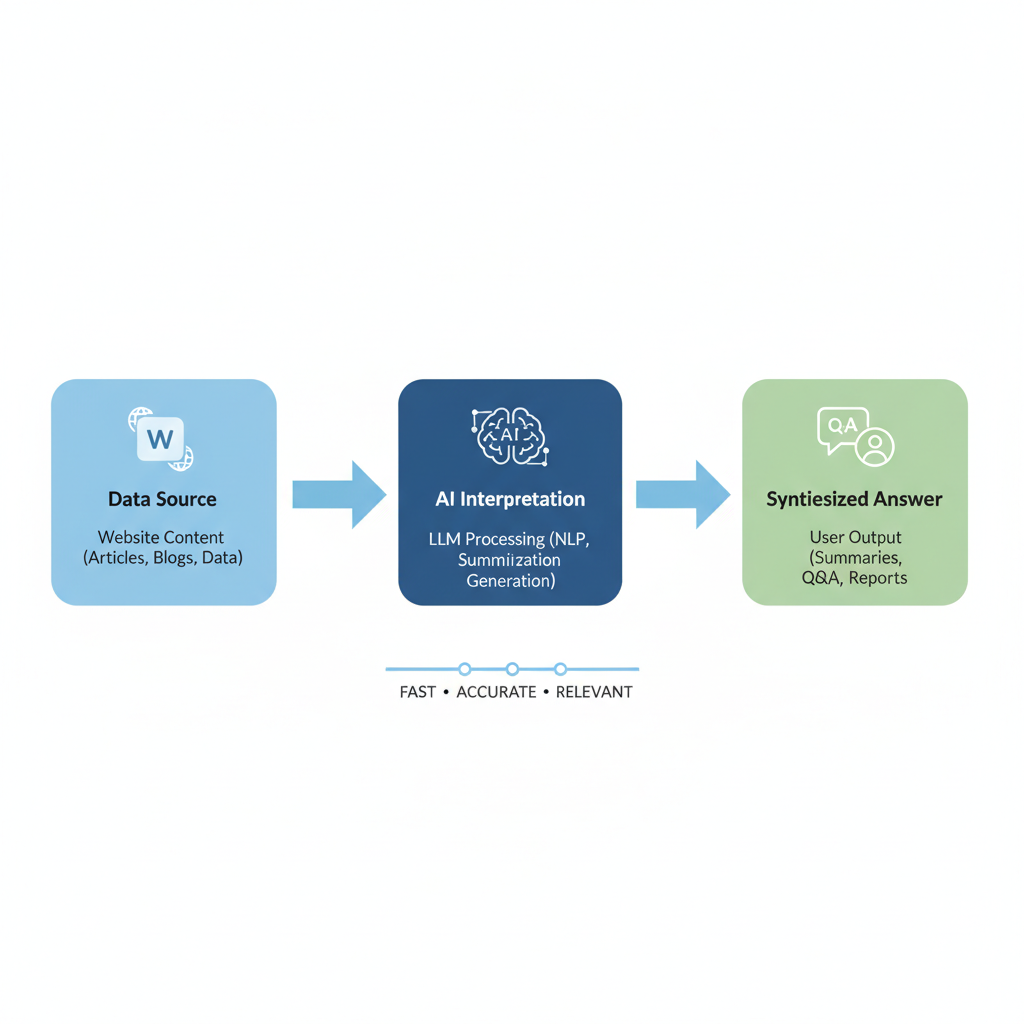
Content must be architected specifically for LLM consumption to earn these critical citations. These models prioritize high-integrity data that can be easily parsed and verified. If your content is not structured for these generative engines, your brand becomes invisible in the primary interface where users now seek information.
The success metric for 2026 is the micro-conversion of being quoted. When an AI cites your specific data point or expert opinion, it reinforces your authority across the entire knowledge graph. This shift requires a move away from generic blogging toward data-dense, structured contributions.
The Scalability Crisis: Why Manual Workflows Fail in 2026
Manual content auditing has become a significant liability in an era where search algorithms iterate on a weekly basis. Traditional SEO strategies relied on quarterly or biannual updates, but the speed of generative engine updates makes this pace obsolete. Relying on human editors to manually track every change in keyword intent or ranking factor creates a “manual chaos” bottleneck.
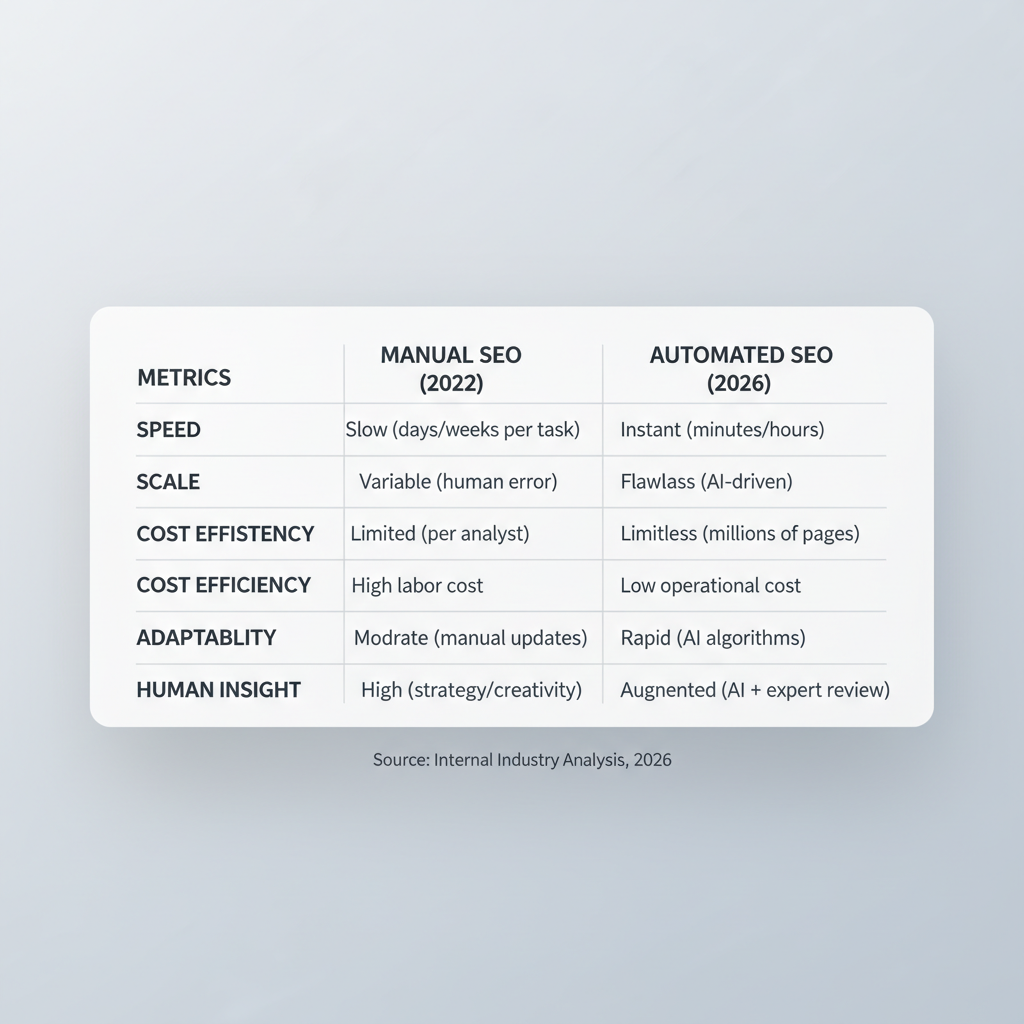
The cost-per-page for manual production is no longer sustainable for SMEs looking to compete with larger enterprises. While a human-only team might take weeks to research and publish a content cluster, automated systems can deploy high-quality, verified content in hours. This velocity is not about volume for the sake of volume; it is about keeping pace with the real-time requirements of search engines.
| Feature | Manual SEO Workflow | Automated SEO Engine |
|---|---|---|
| Update Frequency | Quarterly / Monthly | Near Real-Time / Weekly |
| Time-to-Market | 7-14 Days per article | < 24 Hours for a cluster |
| Scalability | Limited by headcount | Limited by server capacity |
| Error Rate | High (Human oversight) | Low (Systemic validation) |
Maintaining a competitive edge requires a shift in mindset from “content drafting” to “system architecture.” By automating the repetitive elements of SEO, businesses can reallocate human creativity to high-level strategy and unique insight. The gap between those using manual processes and those using automated systems is widening rapidly.
Building the “Search Everywhere” Engine with n8n and Low-Code
Automating the distribution of content across multiple platforms is the core of a “Search Everywhere” strategy. Using n8n, businesses can create sophisticated workflows that handle internal linking, content clustering, and cross-platform syncing simultaneously. This ensures that a single piece of verified insight is reflected on your blog, social media channels, and business directories without manual intervention.

Low-code tools provide the flexibility to build custom SEO engines that fit specific business needs. Instead of relying on generic plugins, n8n allows for the creation of precise data pipelines that monitor ranking changes and trigger content refreshes automatically. This systematic approach transforms SEO from a guessing game into a predictable business process.
5-Step Checklist for Automated SEO Workflows
- Connect your primary data source (CMS) to n8n via API.
- Set up automated monitoring for target topic performance.
- Build a content refresh trigger for declining citations.
- Automate structured data (Schema.org) injection for every new post.
- Sync blog updates to social media and business profiles automatically.
Internal linking is another area where automation provides a strategic advantage. Instead of manually searching for relevant old posts to link to new content, an automated system can scan your entire library and place relevant, context-aware links instantly. This improves site structure and helps search crawlers understand the relationship between your topics more effectively.
Automating E-E-A-T: Proving Authority at Machine Speed
Scaling authority signals like Experience, Expertise, Authoritativeness, and Trustworthiness (E-E-A-T) is the most challenging hurdle for manual teams. Generative engines look for proof of real-world experience, such as case studies and verified results, to validate their citations. Automation can be used to sync these real-world data points directly into your content library, ensuring your expertise is always documented.

Structured data serves as the “API for SEO,” allowing you to feed search engines the specific details they need to trust your content. By automating the generation of Schema.org markup, you provide a clear roadmap of your authors’ credentials and the validity of your claims. This machine-readable proof is often what separates a cited expert from a generic source.
Consistency across the web is also critical for establishing author signatures. Automated workflows can ensure that every time an expert from your company publishes content, their bio, social proof, and professional credentials are perfectly aligned across every platform. This consistency signals to AI models that the information is coming from a reliable, verified source.
FAQ
What is the difference between SEO and GEO?
SEO focuses on ranking websites in a list of results for humans to click. GEO (Generative Engine Optimization) focuses on getting your content cited as a source within an AI-generated answer.
Can I still rank without automation in 2026?
It is possible for very niche or low-competition topics, but for competitive markets, the speed and volume required to keep up with weekly algorithm updates make manual work unsustainable.
How does n8n help with search rankings?
n8n automates the technical “plumbing” of SEO, such as internal linking, content distribution, and metadata updates, allowing your site to maintain higher technical integrity and authority signals at scale.
Is high content velocity considered “spam” by 2026 standards?
Velocity is only considered spam if the quality is low. High-velocity systems that produce verified, data-backed, and well-structured content are viewed as authoritative and helpful by generative engines.
Put this into practice
The transition from manual chaos to a systemic SEO engine begins with identifying your most time-consuming bottlenecks. For many SMEs, this is either the manual distribution of content or the constant need to update old blog posts. Rather than attempting to automate your entire marketing department at once, focus on a single high-impact workflow.
Audit your current manual tasks and identify one specific SEO process to automate using n8n this quarter. Whether it is automating your internal linking or syncing your case studies to your blog, creating a structured system is the only way to ensure visibility in the generative era. Moving toward an automated framework today will provide the strategic advantage necessary to remain competitive in 2026 and beyond.