Blog

  • Beyond the Gut: How Small Sales Teams Scale with AI Lead Scoring

    Key Takeaways: Why AI Lead Scoring is a Strategic Imperative

    AI-powered lead scoring replaces manual intuition with data-driven weights, reducing time wasted on unqualified prospects by up to 30% and increasing sales team morale. This shift from subjective guessing to algorithmic precision fundamentally transforms how your organization identifies high-value opportunities. Have you considered the hidden cost of your sales team manually sifting through lukewarm inquiries? For a typical 10-person B2B sales team, implementing automated scoring can reduce weekly “lead cleanup” meetings from four hours to just thirty minutes, reclaiming valuable time for actual closing activities.

    Beyond simple time savings, this technology establishes a rigorous framework for growth that scales without requiring proportional increases in headcount. By integrating behavioral data and firmographic markers, businesses move from a reactive posture to a proactive strategy. This evolution ensures that your most talented closers focus exclusively on accounts with the highest propensity to convert, effectively maximizing the return on every marketing dollar spent. A systematic approach eliminates the friction often found at the hand-off point between departments.

    This transition toward automated systems provides several distinct advantages for small and medium-sized enterprises seeking to optimize their resources:

    • Mitigation of Qualification Fatigue: Automation removes the cognitive burden of evaluating hundreds of low-intent signals, preventing burnout and ensuring high-value leads receive immediate attention.
    • Standardization of Sales Qualified Leads (SQLs): By establishing a data-backed threshold for readiness, both marketing and sales operate under a single, objective definition of what constitutes a “hot” lead.
    • Real-Time Prioritization: AI models update scores instantly based on prospect behavior, allowing your team to strike while interest is at its peak rather than waiting for manual batch processing.
    • Enhanced Predictive Accuracy: Machine learning identifies subtle patterns in conversion data that human observers often overlook, leading to more reliable revenue forecasting.
    • Operational Efficiency: Low-code integrations allow these systems to function autonomously, syncing data across CRM platforms without requiring constant manual oversight or technical intervention.

    Adopting these automated systems is no longer a luxury but a fundamental requirement for any business aiming to maintain a competitive edge in an increasingly data-centric market.

    The Hidden Cost of ‘Gut Feeling’ Lead Qualification

    The cost of manual lead qualification includes wasted salary on ‘chasing ghosts,’ pipeline bloat that obscures real deals, and decreased sales team morale due to low win rates. Relying on intuition rather than data causes teams to prioritize volume over value. This creates a deceptive sense of activity that masks a stagnant conversion rate. Small teams simply cannot afford this inefficiency. Every hour spent on a dead-end lead is an hour stolen from a high-intent prospect.

    A conceptual image showing a split screen: one side a cluttered, chaotic spreadsheet and the other a streamlined, glowing digital pipeline.
    Generated by Articfly AI

    Consider a sales manager spending 2 hours every morning manually cross-referencing new signups against LinkedIn profiles to guess their budget. This labor-intensive process (often prone to human error) represents a significant drain on high-level talent. Instead of refining closing strategies or nurturing relationships, skilled professionals are reduced to data entry clerks. The financial impact is clear: if a senior rep earns $100,000 annually, losing 25% of their time to manual research equates to $25,000 in lost productivity every year.

    Pipeline bloat occurs when unqualified leads linger in the CRM because nobody has the data to disqualify them. This clutter makes it impossible for leadership to forecast revenue accurately, leading to missed targets and misallocated budgets. It also leads to burnout. Sales representatives thrive on winning. When their days are filled with rejection from prospects who were never a fit to begin with, motivation plummets. A demoralized team is a stagnant team, and stagnation is often the precursor to high turnover rates in competitive sales environments.

    Opportunity costs extend beyond salary. There is the “cost of delay” for legitimate prospects who wait in line while staff “chase ghosts.” In competitive markets, a four-hour delay in response time can be the difference between a closed deal and a lost opportunity. Manual systems are inherently slow. They lack the agility to react to intent signals in real-time, such as a prospect visiting a pricing page multiple times or downloading a specific case study. Without automated triggers, these signals go unnoticed.

    Relying on a “gut feeling” is no longer a viable business strategy. It is a liability. Total lack of scalability. By quantifying these losses, organizations can see that automation is not just a luxury—it is a survival mechanism for the modern sales floor. Transitioning to a data-driven model ensures that every minute of a salesperson’s day is directed toward revenue-generating activities rather than administrative guesswork.

    Defining the Data Points that Actually Predict Conversion

    Effective lead scoring data points include firmographics such as company size and industry, behavioral data like pricing page visits, and technographics which identify a prospect’s current software stack. This requires a structured taxonomy to differentiate between casual browsers and genuine buyers. Firmographic data serves as the foundational filter, ensuring that a lead fits the ideal customer profile. If a lead originates from an enterprise with 500 employees but your service is for solo creators, a score must reflect that misalignment immediately.

    A close-up of a high-resolution tablet screen displaying a lead profile with icons for email engagement, website visits, and company size metrics.
    Generated by Articfly AI

    Behavioral data provides the necessary context regarding a prospect’s current intent level. For instance, identifying that leads who visit the “Pricing” page three times in 48 hours are five times more likely to convert than those who only read blog posts allows for immediate prioritization. Technographics further refine this by revealing if a lead already utilizes compatible tools like n8n. Contextual data adds a final layer by examining the environment of an interaction, such as the referral source.

    Distinguishing between high-intent actions and passive engagement is critical for resource management. Consider a micro-scenario: two leads download the same whitepaper. Lead A stops there, while Lead B proceeds to click a link in the follow-up email and views a “Request a Demo” video. Lead B demonstrates a specific progression through the funnel that warrants a higher score. High-intent actions are those that signal a readiness to buy, such as interacting with a ROI calculator or viewing technical documentation, rather than just consuming top-of-funnel educational content.

    Data validity is inherently tied to time, a concept known as engagement decay. A lead who was highly active six months ago but has not opened an email since is no longer a hot prospect. AI-driven scoring systems automatically depreciate scores over time. This prevents the inflation of scores based on historical actions that no longer reflect current business needs or priorities.

    Actually, it is a mistake to view these data points as a simple checklist where every action adds a flat value. True multi-dimensional scoring requires weighting these variables dynamically. A firmographic match is a prerequisite, but behavioral spikes are the triggers for outreach. By synthesizing firmographic, behavioral, and technographic inputs into a single, evolving metric, SMEs can replace manual chaos with a predictable pipeline. This strategy ensures that every notification sent to a sales representative represents a genuine opportunity rather than a statistical anomaly.

    Building a Scoring Model Without a Data Science Team

    Small teams can build lead scoring models using simple weighted logic (e.g., +10 points for a specific job title) and LLMs to categorize unstructured data like company descriptions. Building a scoring model no longer requires a PhD in data science because low-code tools provide the necessary infrastructure. By translating business intuition into mathematical weights, any founder or sales lead can create a system that prioritizes high-value prospects automatically.

    The process begins with a simple weighted point system where specific actions or attributes receive a numerical value based on their historical correlation with closed deals. LLMs enhance this. They read through unstructured data—such as a LinkedIn bio—to assign categories that would otherwise require manual review. This combination of rigid logic and flexible AI creates a sophisticated filter for any small team.

    A professional in a minimalist office setting using a low-code interface to drag and drop logic blocks, representing the simplicity of building scoring models.
    Generated by Articfly AI

    I recall a founder who mapped out his entire lead qualification process on a basic spreadsheet before moving it into an automation platform. He assigned points to job titles like ‘VP of Operations’ and subtracted points for students or competitors. Once he mirrored this logic in an n8n workflow, the system handled the heavy lifting (and frankly, it was more consistent than his morning coffee habit). This transition from a static sheet to a live, automated scoring engine is where the real efficiency gains happen for SMEs.

    Iterative refinement is far more critical than achieving initial perfection. Your first model will likely be a bit clunky, but that is perfectly acceptable as long as you start. By comparing actual conversions against initial scores, you can refine the underlying weights over time. If high-scoring leads fail to close, simply lower the point value for those specific attributes while raising others. This constant feedback loop ensures the model evolves alongside your market understanding (without needing to write a single line of Python).

    Adopting these low-code scoring systems is a strategic imperative for any business that cannot afford to waste time on low-intent inquiries. While larger competitors might spend months developing custom algorithms, a small team can deploy a functional LLM-based categorizer in a single afternoon. Speed and adaptability are the primary advantages here. By focusing on practical application rather than theoretical accuracy, organizations move from manual chaos to a structured, data-driven sales process that scales without increasing headcount.

    Automating the Pipeline: Using n8n to Centralize Lead Intelligence

    n8n acts as the central hub for lead scoring by pulling data from CRMs, webhooks, and enrichment tools, calculating the score, and pushing notifications to Slack or email. This orchestration layer eliminates the manual overhead of moving data between disparate platforms. By integrating your existing tech stack into a single workflow, you ensure that every lead is processed against the same logic instantly. Imagine a lead arrives via a web form; n8n immediately captures that webhook and initiates a sequence of API calls. It queries external databases to verify company size and revenue before the lead reaches your sales team. This approach transforms fragmented data points into a unified intelligence stream. You no longer need to check multiple tabs to understand a prospect’s value.
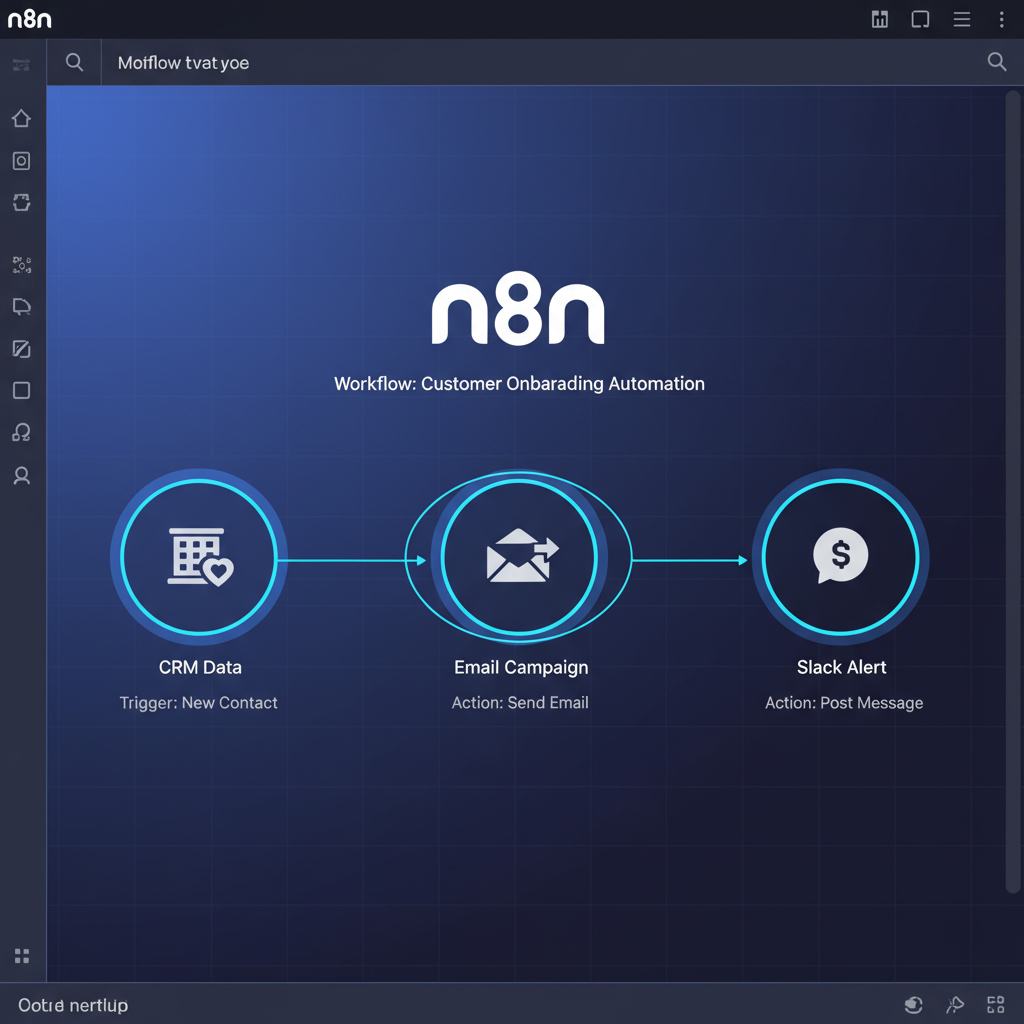
    A visual representation of the n8n workflow interface, showing nodes connecting a CRM, an email marketing tool, and a Slack notification icon.
    Generated by Articfly AI

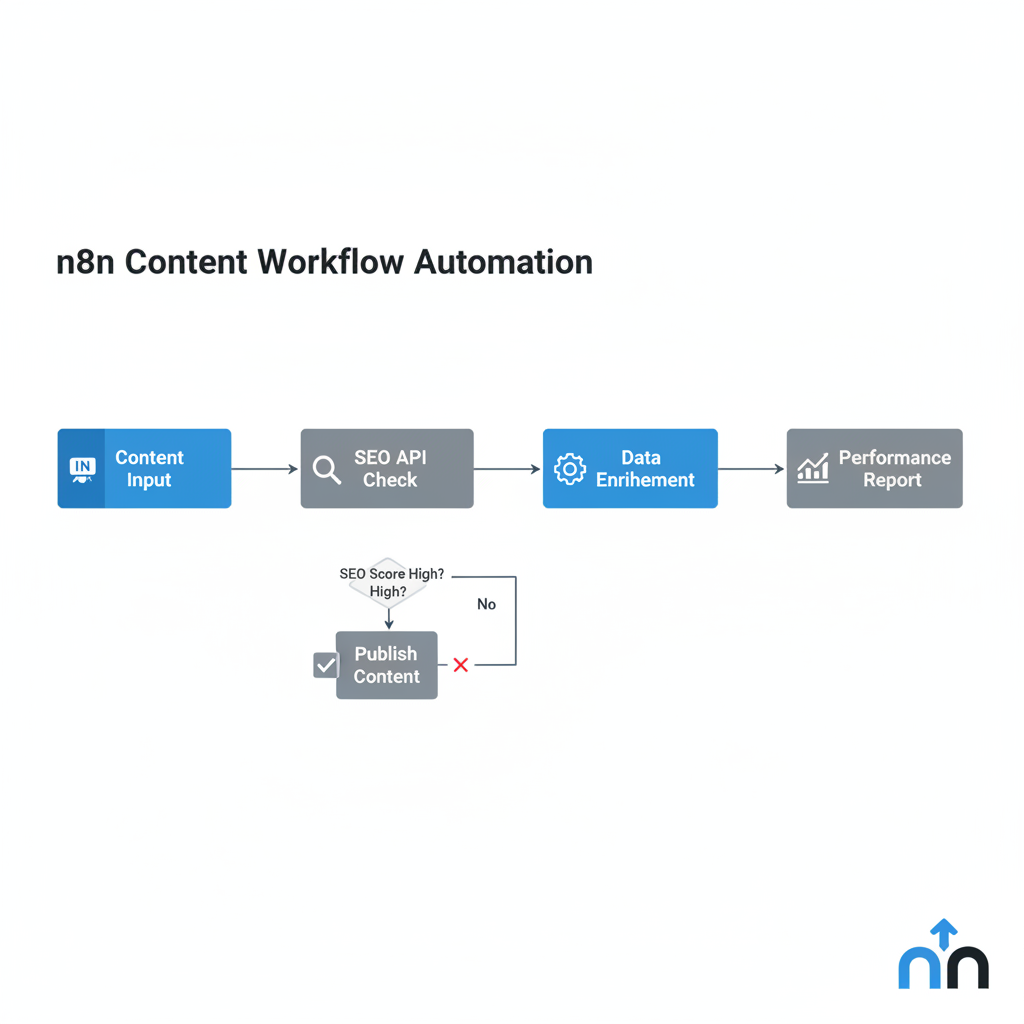
    The architecture of an effective automation pipeline relies on precise triggers. An n8n workflow that triggers when a Typeform is submitted, enriches the data via an API, calculates a score, and creates a high-priority task in HubSpot represents the standard for small teams.

    Conditional routing is where the system truly demonstrates its strategic value. Based on the calculated score, n8n uses “If” nodes to determine the next immediate action. High-value “hot” leads—those matching your ideal customer profile with high intent—trigger urgent notifications in Slack. This ensures your best sales reps engage within minutes. Lower-scoring “warm” leads follow a different path. Perhaps they are added to a specific email nurturing sequence in Mailchimp or assigned a lower priority in the CRM. You control the logic. No lead gets lost in the shuffle. By automating these decisions, you maintain a high velocity for top-tier opportunities while keeping the rest of the pipeline moving through automated touchpoints.

    Consider the technical flow beyond the initial trigger. Once the form submission hits the webhook node, the workflow branches. One path might ping a service like Clearbit or Apollo to fetch missing firmographic details. Another path could check your internal CRM history to see if the contact has interacted with your brand before. These variables then feed into a “Function” node where the scoring math happens. It is a clean, repeatable process that removes human bias. Centralizing lead intelligence through n8n provides a level of operational efficiency usually reserved for enterprise-level corporations. You gain total visibility into your pipeline health. Think about the time saved. Instead of manually researching every LinkedIn profile that downloads a whitepaper, your system does it in seconds. This isn’t just about speed; it is about consistency. Every lead is treated with the same rigorous standard, ensuring that no high-potential account slips through the cracks. Efficiency at scale.

    Implementation Roadmap: From Zero to Automated in 7 Days

    A basic AI lead scoring system can be implemented in one week: 2 days for data auditing, 2 days for n8n workflow construction, and 1 day for testing and rollout. This rapid deployment allows small teams to move from subjective guesswork to data-driven prioritization without months of development. By focusing on a “Minimum Viable Scoring” model, an SME leader can identify the highest-value signals—like job title or pricing page visits—and map them to specific point values.

    Imagine a sales manager setting up this logic on a Tuesday afternoon and receiving their first high-priority Slack alert by Thursday morning. This speed is possible because modern low-code tools bypass the need for custom coding. Instead of waiting for a perfect data set, the focus shifts to immediate utility. Actually, wait—it is better to say the focus shifts to iterative improvement rather than total perfection. Why let a messy CRM prevent you from identifying your best prospects right now? This 7-day roadmap ensures that the transition from manual chaos to a structured, automated engine happens with minimal friction.
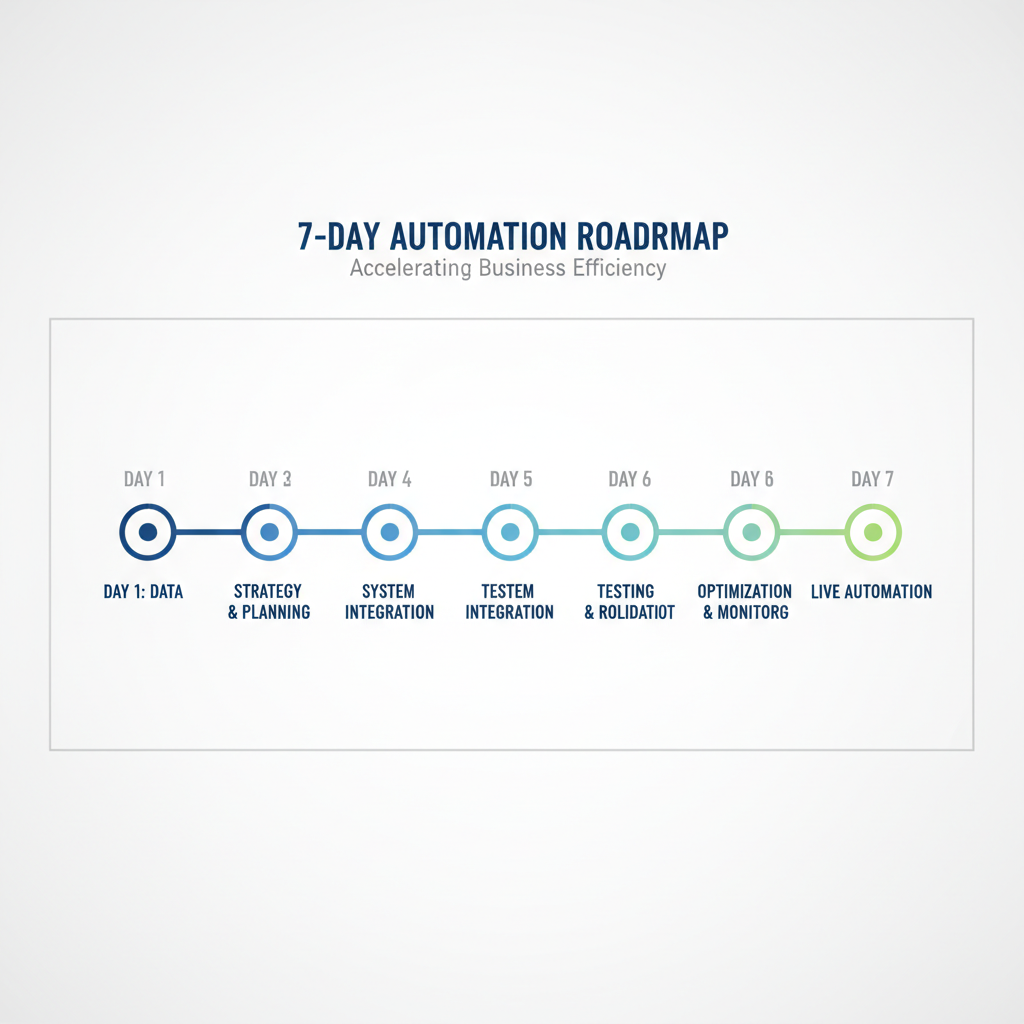
    A clean, minimalist calendar or timeline graphic showing a 7-day progression from 'Data Audit' to 'Live Automation'.
    Generated by Articfly AI

    The first 48 hours are dedicated to the data audit. You must identify where your lead data lives and which fields are actually reliable. Is the “Industry” field consistently filled, or should you rely on email domains? Once the data sources are mapped, the next two days involve building the n8n workflow. This is where the logic lives—connecting your CRM to an LLM that evaluates the lead’s intent and fit. You are not just moving data; you are creating a digital brain that works while your team sleeps.

    Days five and six focus on stress testing and internal alignment. Before the system goes live, run historical leads through the workflow to see if the AI scores them as your top reps would. This calibration phase prevents the “garbage in, garbage out” trap that often plagues poorly planned automations. It is a moment for self-correction: if the scores feel off, you adjust the weighting of the criteria immediately to ensure accuracy.

    On the final day, the team is onboarded. This isn’t a complex technical training but a strategic briefing on how to handle the new alerts. When a “Hot Lead” notification hits a rep’s screen, they should know exactly which talking points the AI suggested. By the end of the week, the manual burden vanishes, replaced by a system that scales with your growth and keeps the sales pipeline moving efficiently.

    Frequently Asked Questions About AI Lead Scoring

    What are the most common concerns regarding AI lead scoring?

    Common questions about AI lead scoring include: Do I need a large dataset? (No, start with rules-based scoring), Is it expensive? (n8n makes it highly cost-effective), and Does it replace sales reps? (No, it empowers them). Implementation triggers hesitation among founders worried about technical complexity. However, the barrier to entry is lower than most assume, especially when using low-code tools that bypass expensive data science teams. Small teams can begin with basic heuristics and introduce machine learning as lead volume grows.

    Starting small allows you to validate logic before committing to advanced models. By utilizing n8n, businesses connect existing CRMs to an AI engine without massive overhead. This modular approach ensures automation grows with revenue, providing a scalable framework. Rather than a rigid black box, modern scoring functions as a flexible extension of your sales strategy, ensuring no high-value prospect slips through the cracks due to fatigue.

    What if the AI misses a high-value lead?

    No one wants to lose a “diamond in the rough” because an algorithm flagged a non-standard email domain. To prevent this, we implement a safety net using manual overrides. If a lead meets high-intent criteria but fails the AI scoring, the system flags it for review. Technology serves as a filter, not a barrier, allowing reps to maintain the final word on quality.

    Is AI lead scoring too expensive for a small business?

    Enterprise solutions carry five-figure price tags, but low-code has changed the math. Using n8n for orchestration allows you to pay only for the compute and API calls you use. You aren’t locked into bloated subscriptions. This cost-effective structure (a relief for bootstrapped founders) makes sophisticated automation accessible to any team, allowing you to compete with larger organizations without their budgets.

    How much data is required to begin?

    You do not need millions of rows of historical data. Many implementations begin with a “rules-plus-AI” hybrid. You define basic parameters like industry or job title, while the AI analyzes the nuance of form responses. As your CRM fills, the system learns from closed-won deals. It is better to start with a functional system today than to wait for a “perfect” dataset.

    Action Steps: Moving from Manual Chaos to a Working System

    To start with AI lead scoring, first audit your last 20 closed-won deals to identify common traits, then sign up for an n8n trial to begin mapping your first automated workflow. This initial audit serves as the foundation for your scoring logic, ensuring your automation reflects actual market success rather than guesswork. Identifying the specific industries, job titles, or pain points shared by your most profitable clients allows the system to prioritize similar leads with surgical precision.

    Once these patterns emerge, the transition from manual chaos to a structured system becomes a matter of technical execution. Imagine a founder opening their CRM and tagging their top 10 customers to find the “common thread” for their first scoring rule. This small, deliberate action transforms a cluttered database into a strategic asset. By mapping these traits into a low-code environment, small teams can effectively replicate the sophisticated lead management capabilities once reserved for enterprise-level organizations.

    The path toward operational efficiency begins with three concrete steps. First, define your Ideal Customer Profile (ICP) by documenting the firmographics and behaviors that characterize your best buyers. Second, select a low-code platform like n8n to connect your lead sources with your CRM. Third, build a simple scoring pilot that assigns points based on just two or three high-value attributes.

    Transitioning to an automated scoring model is not merely a technical upgrade; it is a strategic pivot. Small sales teams no longer need to drown in unqualified inquiries. By implementing these steps, you replace intuition with data-driven clarity. Start today. Build the system that allows your team to focus on closing deals instead of sorting through the noise.
  • How n8n Handles Error Recovery in Multi-Step Workflows: A Technical Guide

    Key Takeaways for n8n Workflow Resilience

    n8n error recovery relies on three pillars: node-level retries for transient issues, Error Trigger workflows for global catch-all handling, and Dead-Letter Queues (DLQ) for manual reprocessing of failed items. Implementing these layers ensures that temporary network fluctuations do not disrupt business-critical operations. Node-level retries address immediate, short-lived failures by attempting the request again after a specified delay, which is particularly effective for rate-limited APIs or minor latency spikes. When a node exhausts its retry attempts, the Error Trigger workflow captures the failure metadata, allowing the system to log the event or notify administrators. For complex data sets, a Dead-Letter Queue stores the failed payload for later inspection and manual re-injection. This tiered approach transforms a fragile sequence into a resilient architecture capable of maintaining uptime. How can your organization move from reactive troubleshooting to a proactive, self-healing automation environment? Establishing a clear hierarchy ensures that human intervention remains the final resort.

    • Automated Node Retries serve as the first line of defense against transient API errors, preventing minor network blips from halting entire workflows.
    • Error Trigger Workflows centralize error logging across multiple production environments, providing a single source of truth for failure monitoring.
    • Dead-Letter Queues (DLQ) preserve data integrity by holding failed items for manual review, which prevents the permanent loss of valuable transaction records.
    • Standardized Error Templates reduce debugging overhead by providing consistent failure context, such as execution IDs and node names, across all active projects.

    Technical operators managing over 50 production workflows often implement these standardized templates to reduce manual debugging time by 70%, allowing your team to focus on strategic development instead of maintenance.

    The Hidden Danger of Silent Failures in Production

    Silent failures in n8n occur when a workflow continues despite a logic error or partial data loss, leading to corrupted state across downstream systems. Loud crashes are preferable as they stop the propagation of bad data. While a stopped workflow requires manual intervention, it prevents the injection of invalid information into a CRM or ERP, which often costs significantly more to rectify than a simple restart. Strategic resilience relies on the visibility of errors rather than the mere appearance of uptime.

    When a node is configured to “Continue On Fail,” the workflow treats a null response or a 404 error as a valid step in the sequence. This behavior bypasses standard error-handling triggers, leaving the system in an inconsistent state where subsequent nodes process incomplete data sets. Systems that allow these partial successes often create a debt of “ghost data”—records that exist in a database but lack the necessary attributes for functional business use.

    Suppose an e-commerce automation is designed to sync Shopify orders with a third-party logistics (3PL) provider. If the workflow encounters a missing customer shipping address but is set to ignore errors, it might successfully trigger the fulfillment API without the necessary destination details. The result: 100 unshipable orders stuck in a warehouse queue. This scenario illustrates how a “successful” execution status in the n8n dashboard can mask operational disasters. A hard stop at the point of failure would have isolated the issue to a single order, rather than polluting the entire fulfillment batch.

    Teams that prioritize data integrity over vanity uptime metrics often avoid global “Continue On Fail” settings for critical paths. Instead, granular error handling—such as using the Error Trigger node or conditional branching—ensures that failures are explicit and actionable. A loud crash acts as a circuit breaker (a mechanism often missing in simplified automation setups). It protects the organization from the compounding costs of bad data, which research from Gartner suggests costs organizations an average of $12.9 million annually due to poor decision-making and manual cleanup.

    Node-Level Resilience: Configuring Retries and Wait Intervals

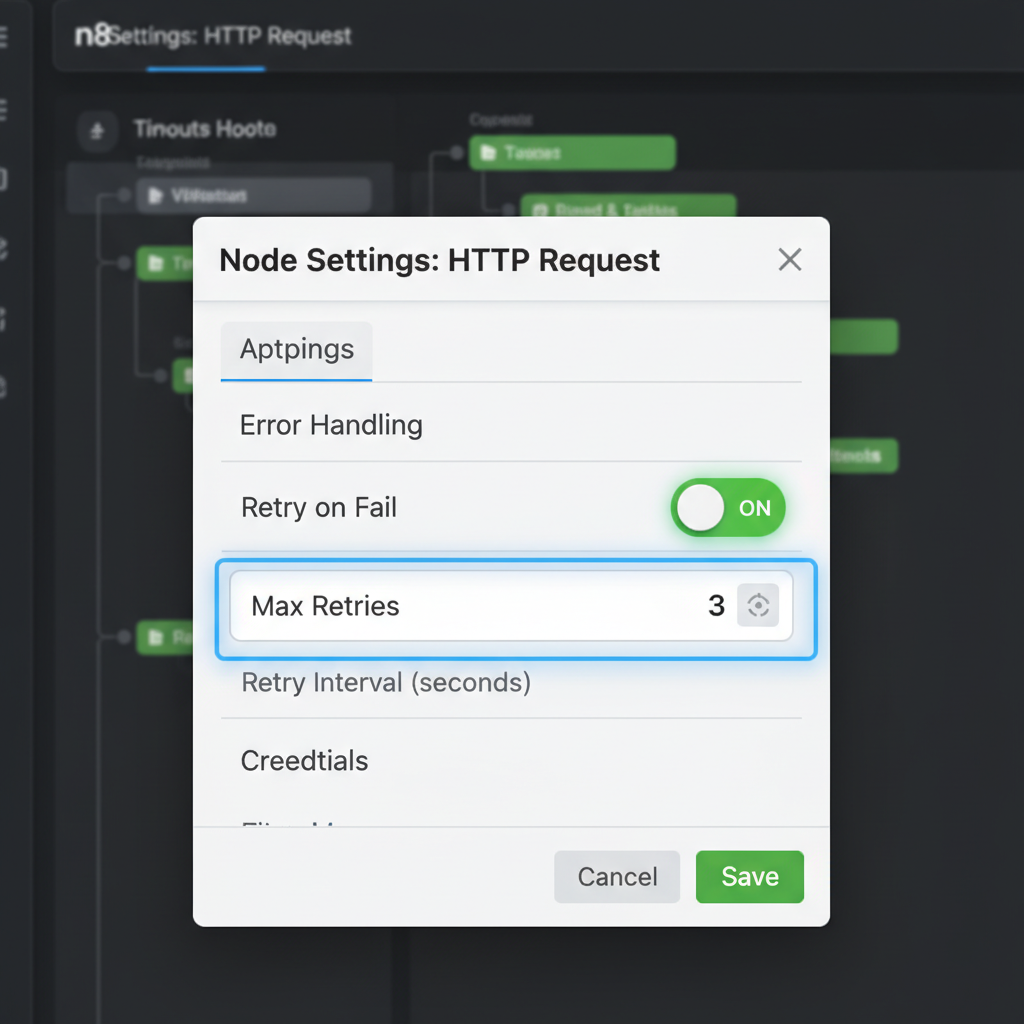
    n8n’s built-in retry mechanism allows nodes to re-attempt execution up to 5 times with configurable wait intervals, effectively handling 429 (Rate Limit) and 503 (Service Unavailable) HTTP errors. This native functionality serves as the primary defense against transient network issues or temporary service outages that would otherwise terminate a workflow. By enabling the “Retry on Fail” toggle within the node settings panel, developers define exactly how many attempts the system should make before moving to a failure state. This granular control ensures that intermittent API timeouts do not disrupt the entire data pipeline.

    A close-up screenshot of the n8n node settings panel focusing on the 'Retry on Fail' toggle and 'Max Retries' input field.

    Wait intervals provide the necessary breathing room for external services to recover or for rate limits to reset. In production environments, setting a “Wait Between Tries” value (measured in milliseconds) prevents the automation from immediately hammering a struggling server with repeated requests. This approach transforms a fragile sequence into a resilient system capable of self-healing during minor infrastructure hiccups. Instead of manual intervention, the workflow pauses and resumes automatically.

    Configuring these settings requires a balance between rapid recovery and service etiquette. For instance, a LinkedIn API node might trigger a strict rate limit during peak hours, necessitating a 5-minute wait interval to ensure the next attempt succeeds. (Actually, 300,000 milliseconds is the limit n8n accepts for these fields, which is often just enough for most social media cooldowns). If the wait is too short, the automation risks being flagged for abusive behavior. Teams that implement a 3-attempt limit with a 60-second delay for standard REST API calls often see a significant reduction in workflow restarts. This configuration handles the vast majority of “blip” errors without manual oversight.

    Operational efficiency improves when technical debt is managed at the node level rather than through complex global error handlers. While global catch-all workflows are useful for reporting, node-level retries address the root cause of instability immediately. This local resilience minimizes the logs that engineers must review, as successful retries are typically handled silently within the execution history. Is it more efficient to build a complex recovery loop or to simply toggle a native setting? The data suggests that simple node-level configurations resolve over 80% of transient connection issues in high-volume environments.

    Global Error Handling with the Error Trigger Node

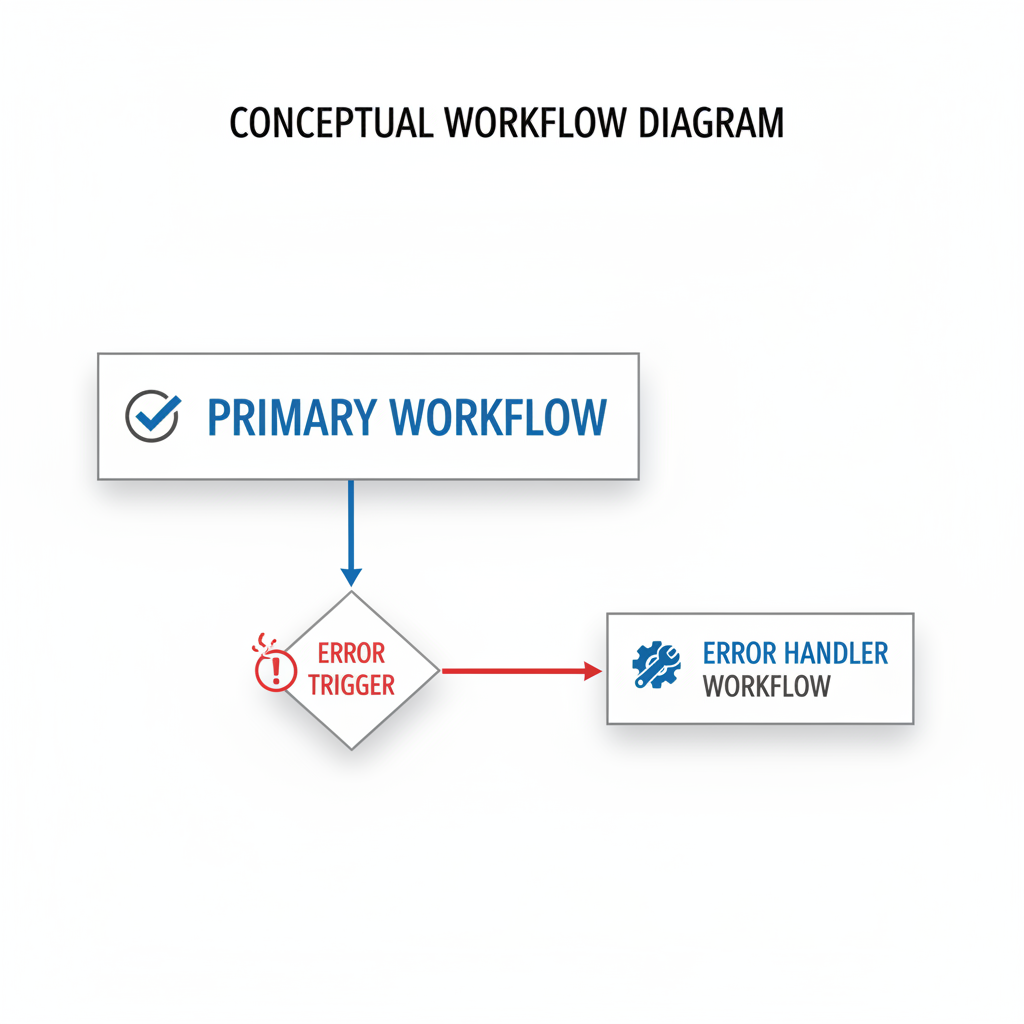
    The Error Trigger node in n8n is a specialized trigger that executes a separate workflow whenever a node in the main workflow fails, passing the error object and execution ID as JSON. This allows teams to build a dedicated “Error Handler” workflow that acts as a central repository for failure logic, rather than cluttering every individual automation with repetitive notification nodes. When a workflow is configured to use an error handler, any unhandled failure triggers this secondary process, providing the exact node name and error message.

    A conceptual diagram showing a primary workflow connecting to a secondary 'Error Handler' workflow via an Error Trigger node.

    Centralizing these responses ensures that updates to notification channels—such as switching from Slack to Microsoft Teams—only require a single change in one workflow. By decoupling the failure response from the primary business logic, the architecture remains lean and readable. This structure prevents the “spaghetti” design often seen in complex automations where every third node is a conditional branch for error reporting. It transforms error management from a reactive, manual task into a predictable system.

    Implementing this architecture involves setting the “Error Workflow” property in the main workflow settings. Once linked, the Error Trigger node receives a payload containing the executionId, which serves as a unique identifier for debugging. A sophisticated error handler might use this ID to fetch the full execution history via the n8n API, then format a JSON payload for an external logging service like Loggly or a private Grafana instance. This approach provides a historical record of failures that simple email alerts cannot match. By routing these logs to a PostgreSQL database, teams can track failure rates over 30-day periods to identify recurring bottlenecks in third-party API response times.

    Teams that adopt this centralized model often find that their primary workflows become significantly easier to maintain. Instead of managing dozens of individual “On Error” paths, developers focus on the core business objective, whether that is lead routing or automated billing. If a database connection fails in a production environment, the error handler can automatically log the incident to a Jira ticket and ping the on-call engineer with a direct link to the failed execution. This link points exactly to the node that stalled, saving minutes of manual searching. Pure efficiency. (It’s a stark contrast to the manual chaos of hunting through logs after your client reports a missing report.) This systemic approach ensures that no failure goes unnoticed, even as your automation stack scales to hundreds of active workflows. It moves the organization from reactive fire-fighting to a state of architectural maturity.

    Implementing a Dead-Letter Queue (DLQ) Pattern

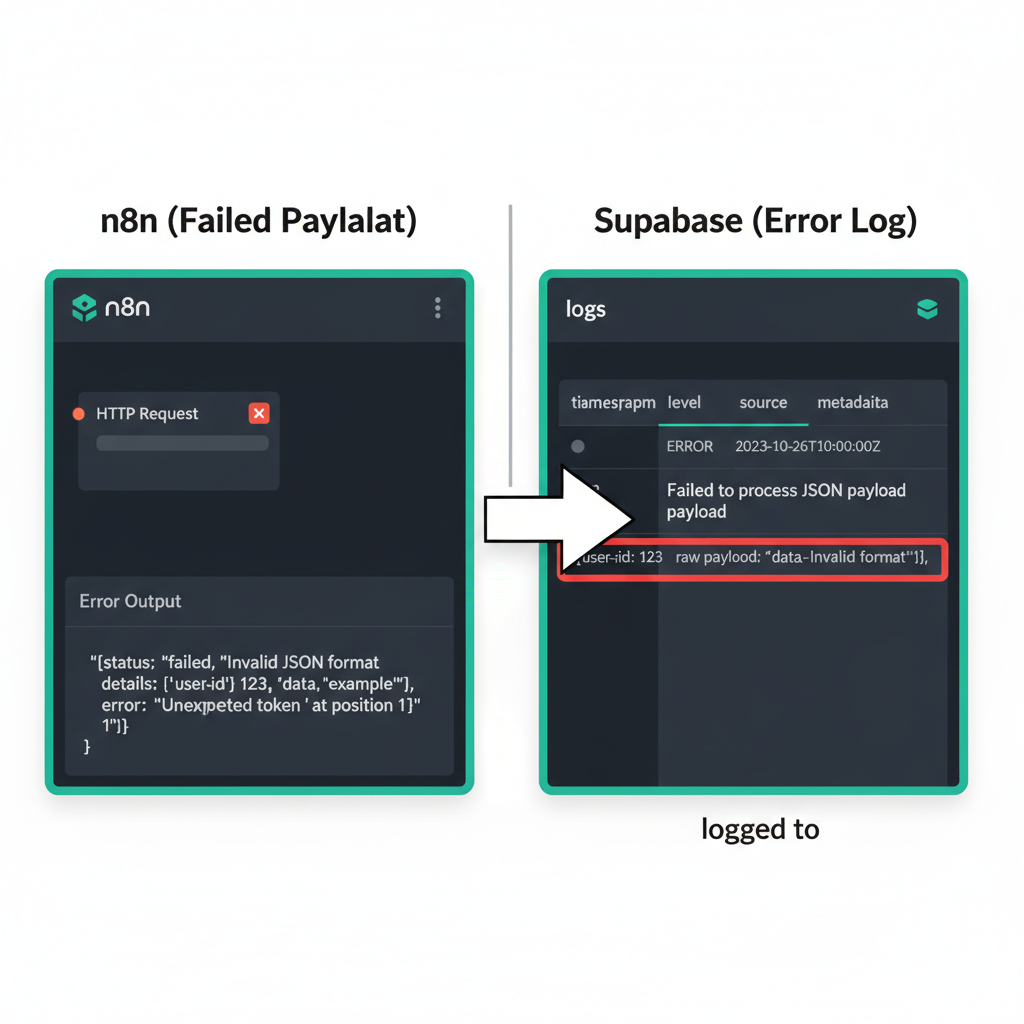
    A Dead-Letter Queue (DLQ) in n8n is a design pattern where failed data payloads are written to a persistent store like Supabase or Google Sheets for later inspection and manual re-injection into the workflow. This architectural approach handles non-transient errors—issues that simple retries cannot fix, such as schema mismatches or invalid API keys—by isolating the problematic data from the primary execution path. Instead of allowing a workflow to fail silently or halt entirely, the system captures the raw JSON input, the error message, and a timestamp into an external database.

    Teams implementing this pattern gain a safety net for high-volume operations where data loss is not an option. By centralizing failures in a structured table, administrators can audit the specific cause of each rejection without digging through execution logs. This setup transforms a technical failure into a manageable task list, allowing for bulk corrections once the underlying issue is resolved.

    A split-screen view showing a failed JSON payload in n8n on one side and its corresponding log entry in a Supabase table on the other.

    Choosing the right storage medium for a DLQ depends on the volume of transactions and the technical proficiency of the team managing the recovery. Google Sheets offers an accessible interface for non-technical users to edit data before re-triggering, yet it often struggles with rate limits when handling hundreds of concurrent error writes. In contrast, using a Supabase table with a ‘status’ column (Pending, Failed, Retried) provides the performance needed to manage 500+ failed lead records during a CRM outage without performance degradation. This relational approach allows for sophisticated filtering, automated status updates, and the use of Postgres-specific features like JSONB columns to store raw error objects for deep inspection.

    The workflow configuration requires more than just a simple “Write to Database” node. An effective setup ideally includes a secondary “Recovery” workflow that monitors the DLQ table for records marked as “Ready to Retry.” When a technician fixes a malformed email address or updates a missing field in the database, the recovery logic picks up the change via a polling trigger or a database webhook and pushes the payload back to the original entry point. Why leave data recovery to chance when a structured log provides a clear audit trail? Including the original execution ID and the specific node name where the failure occurred reduces the time spent on manual troubleshooting from hours to minutes.

    Total control over the error lifecycle. While n8n’s internal execution history is useful for debugging, it is ephemeral and difficult to query at scale. Moving error data into a dedicated environment ensures that even if the n8n instance experiences downtime, the record of what failed remains intact and actionable. Systems that treat error handling as a data management problem rather than a temporary glitch achieve higher reliability and better alignment with business continuity goals.

    Handling Partial Success in Batch Processing

    When processing batches in n8n, use the ‘Split In Batches’ node combined with a sub-workflow to ensure that a single item failure doesn’t kill the entire batch execution. This architectural pattern isolates every record or group of records into its own execution context. By configuring the ‘Execute Workflow’ node to continue on fail or by handling errors within the sub-workflow itself, the parent process remains stable even if individual items encounter issues. For instance, if an automation attempts to update 500 records in a CRM like Salesforce and 10 records contain invalid email formats, the sub-workflow approach allows the 490 valid records to process successfully while logging the specific failures. This prevents the “all-or-nothing” scenario where a single bad data point triggers a global workflow crash. Implementing this strategy maintains operational continuity and ensures that high-volume data pipelines remain resilient against minor data quality discrepancies.

    Isolating failures within large data batches prevents a single malformed entry from halting a multi-hour automation. In a scenario where 1,000 blog posts are being migrated to a headless CMS like Contentful, five posts might contain invalid HTML tags that trigger API errors. Without isolation, the entire workflow would stop at the first error, leaving 995 posts unprocessed. By wrapping the logic in a sub-workflow, the system logs the five specific errors but completes the remaining 995 entries without manual intervention. This granular control is particularly useful when dealing with third-party APIs that have strict validation rules or unpredictable uptime.

    The “Split In Batches” node serves as a flow control mechanism that breaks a large JSON array into smaller subsets, typically sized between 1 and 50 items depending on API rate limits. Teams that implement a loop back to this node after each sub-workflow execution create a persistent processing cycle. If a sub-workflow fails, the parent workflow catches the error through an “On Error -> Continue” setting on the Execute Workflow node. This ensures the loop persists, allowing the system to move to the next batch immediately (which is vital for time-sensitive syncs).

    Maintaining operational continuity during high-volume processing requires moving away from linear execution. Instead of viewing a batch as a single unit of work, resilient systems treat each batch item as an independent transaction. This shift reduces the time spent on manual restarts and data cleanup. Organizations that adopt this granular approach often report higher reliability in their content distribution and lead management pipelines, as the system self-corrects by bypassing problematic data points rather than collapsing under them.

    Monitoring and Alerting Strategies for n8n Operators

    Effective n8n monitoring involves sending structured alerts to Slack or Discord that include the workflow name, error type, and a direct link to the execution log for rapid triage. This approach shifts the response from reactive discovery to proactive resolution, minimizing the Mean Time to Recovery (MTTR) for critical business processes. When a workflow fails, the primary objective is context. Engineers need to diagnose the issue without manually digging through execution histories.

    A smartphone displaying an 'ERROR' message surrounded by vibrant red and green reflections indoors.
    Photo Polina Zimmerman from Pexels

    Slack Block Kit allows for the creation of rich, interactive notifications that outperform standard text strings. A high-performing alert might feature a “Retry Now” button that triggers a separate webhook to re-process the specific failed item (a pattern that saves significant time during API rate-limit spikes). By including the specific error message, the workflow ID, and the timestamp directly in the block, teams can distinguish between transient network blips and logic-breaking data issues at a glance. You might find that this level of detail prevents the alert fatigue that often plagues growing automation stacks when notifications lack actionable data.

    Beyond native Slack nodes, integrating external monitoring tools provides a secondary layer of operational security. Tools like Uptime Kuma can monitor the n8n instance heartbeat, while services like Sentry or Datadog can ingest logs for long-term trend analysis. If a high-volume workflow processing 5,000 leads per day suddenly drops to zero, a simple heartbeat check won’t catch it, but a custom monitoring node tracking throughput will. These external systems act as a fail-safe—especially if the n8n instance itself goes offline (which is often the case with self-hosted Docker deployments)—ensuring that silent failures do not persist for days.

    Operational excellence in automation requires a shift in focus from “if it breaks” to “how fast it is fixed.” Reducing MTTR often hinges on the quality of the initial notification. When an operator receives a link that takes them directly to the failed node in the n8n canvas, the diagnostic phase is virtually eliminated. This efficiency allows technical teams to manage hundreds of active workflows without a proportional increase in maintenance hours. You can effectively scale operations by treating error logs as a data source for continuous workflow improvement rather than just a list of problems to solve.

    Frequently Asked Questions about n8n Error Recovery

    Common n8n error recovery questions involve the difference between node retries and error triggers, and how to handle memory-related crashes. Node-level retries manage transient network issues by re-executing a specific step multiple times based on defined intervals. Error triggers, conversely, capture workflow-level failures to initiate global recovery logic, such as logging the incident to a database or alerting an administrator via Slack. These two mechanisms serve distinct purposes: one focuses on immediate task persistence, while the other ensures system-wide visibility when a process halts.

    Handling memory-related crashes requires understanding n8n’s execution modes. When a workflow processes large datasets—such as a 50,000-row CSV import—the Node.js process can exceed its allocated RAM, leading to an “Out of Memory” error. Technical teams mitigate this by splitting data into smaller batches or using the “Own Process” execution mode to isolate resource consumption. This prevents a single heavy workflow from crashing the entire n8n instance.

    What is the difference between linear and exponential backoff in n8n?

    n8n provides two primary retry strategies: linear and exponential backoff. Linear backoff uses a fixed interval, such as retrying every 30 seconds, which works for minor API rate limits. Exponential backoff doubles the wait time between each attempt, which is more effective for severe server outages. This approach reduces the load on the target server, increasing the likelihood of a successful connection as the service stabilizes.

    How is a custom backoff strategy implemented beyond the built-in settings?

    Advanced workflows often require logic that standard settings cannot provide. A common pattern involves a “Wait” node coupled with a “Loop” that increments a counter. If an HTTP Request node fails, the workflow routes to a Function node that calculates a custom delay based on the current attempt count. This allows for complex logic, like skipping retries during specific maintenance windows. Useful for high-volume environments.

    Why do some errors bypass the Error Trigger node?

    The Error Trigger node only catches unhandled errors within the workflow execution. If a node has “Continue on Fail” enabled, the error is technically “handled” by the node, and the workflow proceeds to the next step. Consequently, the Error Trigger will not fire because the execution status remains “Success” despite the individual node’s failure. Teams should audit node settings to ensure critical failures bubble up to the global handler.

    Action Steps: Hardening Your n8n Workflows

    Improving n8n resilience involves auditing critical workflows for ‘Retry on Fail’ settings and implementing a basic Error Trigger workflow for Slack notifications. This proactive approach ensures that minor API timeouts or rate limits do not derail high-priority operations like lead processing or automated billing. By centralizing these failures into a dedicated monitoring channel, teams identify recurring bottlenecks before they impact service delivery or customer experience.

    Establishing a standardized error-handling framework allows SMEs to transition from reactive troubleshooting to a model of operational excellence. When every workflow follows a uniform logging structure, the time required for root-cause analysis drops significantly (a task often ignored until a major API outage occurs). This consistency transforms technical logs into actionable business intelligence. How many hours are currently lost to manually tracing logs across disconnected automation instances?

    High-performing organizations typically follow a structured audit to harden their automation infrastructure. Implementing these specific steps reduces the technical debt associated with fragile designs:

    • Criticality Mapping: Identify workflows where a 15-minute delay impacts revenue—such as Stripe payment webhooks or CRM lead routing—and prioritize these for immediate hardening.
    • Standardized Error Triggers: Create a global “Error Handler” workflow that accepts data from any failed node, formatting it into a concise alert containing the Workflow ID and the specific execution URL.
    • Retry Logic Calibration: Configure HTTP Request nodes with an exponential backoff strategy—three retries over five minutes, for example—to handle transient server errors without manual intervention.
    • Credential Health Checks: Schedule a weekly automated test of API credentials to ensure that expired tokens do not cause silent failures in legacy integrations.

    The transition from manual chaos to a resilient system requires viewing automation as a core business asset. Teams that treat error logs as data points for optimization instead of noise tend to scale operations with far fewer headcount additions.

  • SEO in 2026: Why Strategic Automation is the New Competitive Standard

    Key Takeaways for SEO in 2026

    In 2026, SEO success is defined by three pillars: Information Gain, automated content lifecycle management via low-code tools, and optimization for AI-driven Answer Engines (AEO). The strategic transition moves organizations away from high-volume, low-quality publishing toward a model where precision and unique data points dictate ranking potential. Search engines now prioritize “Information Gain,” a metric rewarding content that adds new facts or perspectives not already present in the top 10 results.

    Marketing leads are increasingly replacing manual research with n8n-driven workflows that scan competitor gaps and identify unique angles in real-time. For instance, a marketing lead at a 20-person digital agency reduced content production time by 70% while increasing organic visibility through automated internal linking and data-backed research. Such systems allow teams to maintain editorial quality at scale without the traditional overhead of manual oversight. Integrating low-code automation enables businesses to ensure every published asset serves a specific role within a broader Answer Engine strategy. This shift from manual drafting to system-led orchestration represents the primary competitive advantage for the coming decade.

    How does a modern marketing department survive when traditional keyword density no longer guarantees traffic? A necessary evolution. The following shifts outline the required strategic pivots for 2026:

    • Transition from SEO to AEO: Visibility now depends on appearing in AI-generated summaries (like Google’s Search Generative Experience or Perplexity), which requires structured data and high-authority citations.
    • The Information Gain Mandate: Content that merely reformulates existing web data faces immediate devaluation; success requires original data, unique case studies, or proprietary insights.
    • Low-Code Content Orchestration: Using tools like n8n to automate the heavy lifting of SEO—such as SERP analysis, schema markup generation, and cross-platform distribution—becomes the standard for lean teams.
    • Systemic Consistency over Manual Effort: Moving from a chaotic, ad-hoc publishing schedule to a structured, automated pipeline ensures that technical SEO requirements are met 100% of the time without human error.
    • Data-Driven Feedback Loops: Implementing automated reporting that connects search performance directly to content updates allows for rapid iteration based on real-time ranking shifts.

    The focus remains on building a resilient architecture that supports these three pillars through specific n8n nodes and API integrations.

    The Shift from Search Engines to Answer Engines (AEO)

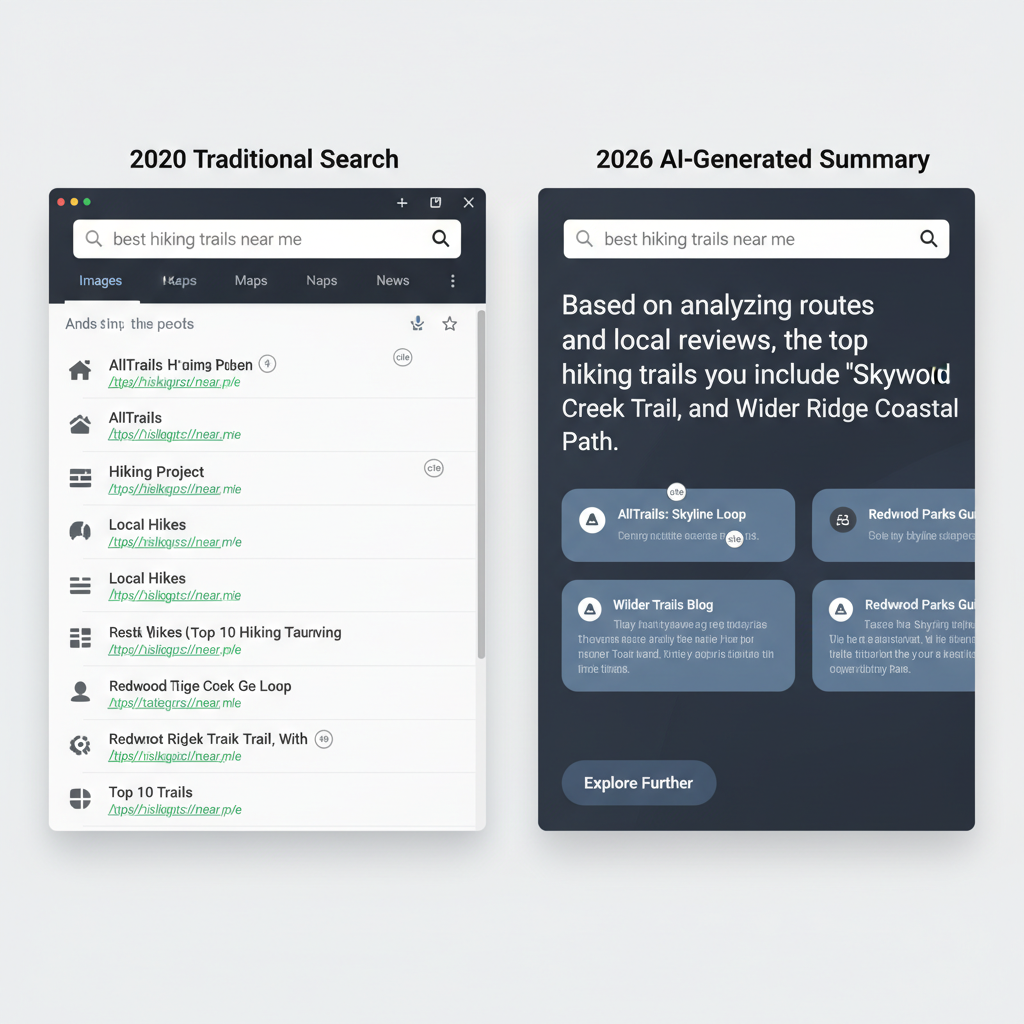
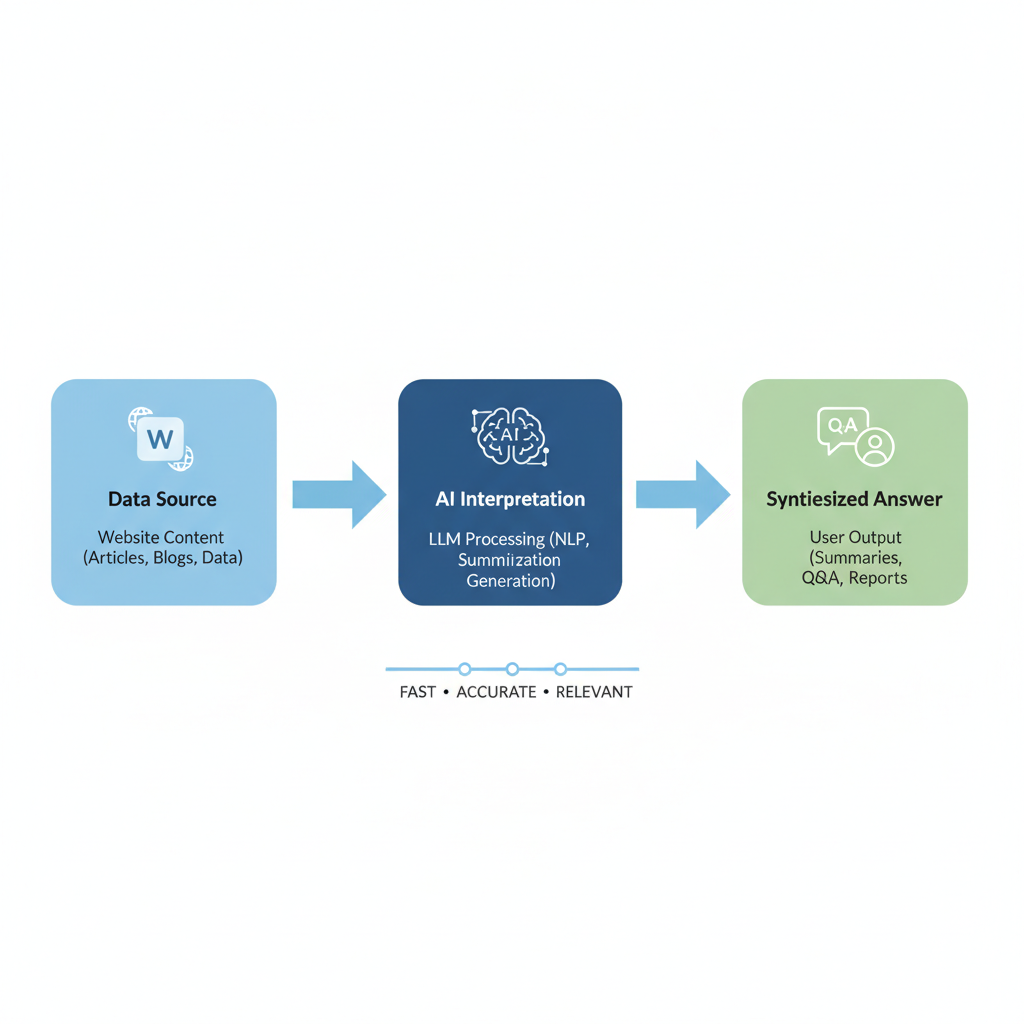
    Search Engines in 2026 function as “Answer Engines,” where LLMs synthesize web data into direct responses, making “Citations” the new “Clicks.” Such a shift prioritizes the delivery of immediate, context-aware information directly on the search results page, often bypassing the traditional website visit entirely. For businesses, visibility now depends on becoming the primary source of truth that an AI model selects to generate its summary. Instead of optimizing for keyword density to rank 1st, technical teams focus on structuring data so that Large Language Models (LLMs) can parse, verify, and attribute facts to a specific brand.

    A side-by-side comparison visualization: one side showing a traditional 2020-era list of blue links, the other showing a sophisticated 2026 AI-generated summary with cited source cards.

    A user asking a complex multi-step query about business automation—such as “how to sync n8n with Supabase while maintaining data integrity across three environments”—receives a synthesized 300-word answer with three distinct brand citations. An AI-heavy environment renders the standard “blue link” list secondary to a cohesive narrative. Data from industry tracking suggests that over 65% of queries now result in zero-click outcomes, forcing a transition from traffic-based metrics to citation-share metrics.

    Structuring content for LLM extraction requires a departure from long-form narrative fluff toward high-density, schema-heavy data blocks. A technical blog post that includes a JSON-LD snippet describing a specific workflow (like an n8n JSON export wrapped in a <script type=”application/ld+json”> tag) provides the clear nodes and connections an AI needs to cite the solution accurately. LLMs favor content that uses semantic HTML5 tags like <section> and <aside> to separate core logic from supplementary advice. A 10-person marketing team might find that adding a “Key Technical Specifications” table to every article increases their citation frequency in Perplexity and ChatGPT-4o search results. (Actually, Perplexity’s crawler prioritizes structured lists and tables when generating its “Sources” cards at the top of the interface).

    The transition to answer-centric search demands a rigorous audit of how information is presented to non-human crawlers like those from OpenAI and Perplexity. Teams that implement automated verification steps—checking that every claim is backed by a schema.org FactCheck or ClaimReview property—reduce the risk of being ignored by AI aggregators. If an automation agency publishes a guide on “Lead Scoring in 2026” without providing a downloadable or scrapable logic gate diagram, they lose the citation to a competitor. Specificity wins in the age of the n8n JSON export.

    Information Gain: The Only Defense Against AI Content Saturation

    Information Gain is a scoring mechanism that rewards content for providing new information not found in other documents the user has already seen. This metric measures the uniqueness of a dataset or insight relative to the existing search index. Search algorithms use this score to filter out the “AI Content Paradox”—a phenomenon where the ease of generating text leads to a surplus of derivative, low-value articles that offer no incremental utility. When every site uses the same underlying Large Language Models (LLMs) to write about “business efficiency,” the resulting articles share identical semantic patterns and factual density.

    Content creators often fall into the trap of summarizing existing top-ten results, which creates a feedback loop of stagnation. High Information Gain scores come from data points that cannot be hallucinated or scraped from existing summaries. Original research, proprietary case studies, and internal telemetry data serve as the primary defense against being buried by automated competitors. (Google’s 2022 patent on Information Gain scores explicitly mentions penalizing redundant documents within a single user session). By providing a different perspective or a new set of variables, a document becomes statistically more valuable to an engine trying to satisfy a user’s need for a thorough understanding.

    Consider a 15-person marketing agency that published a survey of 400 manufacturing CEOs regarding their n8n adoption rates. While high-authority tech blogs summarized the findings, the original report maintained the top ranking for “automation trends 2025” despite having a lower domain rating. Actually, value is derived from the delta of the specific data provided rather than the authority of the domain. Pure novelty. Such results demonstrate that raw data ownership trumps aggregate content volume. A single proprietary dataset can generate dozens of backlinks from larger sites that lack the means to conduct their own primary research, effectively turning competitors into a distribution network for the brand’s original insights.

    SMEs often struggle to compete with enterprise budgets, yet original research remains a low-cost differentiator. A single CSV export of customer support ticket resolution times before and after implementing a Python-based triage script provides more Information Gain than ten generic “benefits of AI” blog posts. Teams that prioritize these unique data captures build defensible search positions. Long-term visibility is secured by anchoring content in unreplicable facts rather than stylistic flair. For example, a specialized logistics firm could publish a 12-month study on how specific temperature-controlled sensor configurations reduced spoilage by 14%—a detail no AI could invent without access to that specific IoT fleet data and historical shipping manifests.

    Scaling with Precision: The Role of n8n and Low-Code in 2026 SEO

    n8n and low-code tools allow SMEs to automate the “drudge work” of SEO—like internal linking and schema markup—allowing humans to focus on high-level strategy and original research. A content team using an n8n workflow to automatically scan new blog posts, suggest internal links based on semantic relevance, and deploy Schema.org markup via API exemplifies this shift. By connecting a headless CMS like Strapi to a vector database, these systems identify existing articles that share contextual overlap without manual searching. This setup ensures that every new piece of content contributes to a cohesive site architecture immediately upon publication. Such configurations move the needle for resource-constrained teams by handling the technical execution that usually lags behind content production. Integrating these workflows often reduces the time spent on post-launch optimization by 70% for small digital agencies.

    Vivid close-up of code on a computer screen showcasing programming details.
    Photo Godfrey Atima from Pexels

    Beyond basic linking, low-code environments facilitate complex data operations like dynamic schema injection for FAQ sections or product reviews. An n8n workflow can trigger upon a status change in Airtable, fetch the latest pricing from a Stripe API, and update the JSON-LD script on a specific URL via the WordPress REST API. For competitive intelligence, teams build custom scrapers that monitor the top 10 SERP results for specific keywords every 24 hours. These scrapers extract headers, word counts, and image alt text, then pipe that data into a Google Sheet for immediate gap analysis. (Actually, using the ‘Execute Command’ node in n8n allows for running Puppeteer scripts for more complex JS-heavy scraping). Automating this process removes the need for expensive third-party monitoring tools that often lack granular data export options and cost upwards of $200 per month.

    Large-scale content updates often fail due to the manual effort required to refresh metadata across hundreds of pages. A 10-person marketing department can use a single workflow to sync their internal product database with their blog’s Open Graph tags whenever a feature name changes. Consistency remains intact without a developer’s intervention. Instead of manual audits, the system checks the status code of every outbound link in a blog post every Sunday night. If a 404 or 500 error is detected, the workflow sends a Slack notification to the content lead with the specific broken URL and the page it resides on. The system prevents the slow decay of “link equity” that occurs when high-authority pages link to dead resources. Technical precision over manual guesswork. A necessary safeguard for high-traffic domains. Engineers running 50+ workflows often find that the “Merge” node is the most effective way to combine SEO data from multiple sources like Google Search Console and Ahrefs into a single Retool dashboard.

    Technical SEO 2.0: Optimizing for LLMs and API-First Indexing

    Technical SEO in 2026 focuses on ‘Machine Readability,’ ensuring that LLMs can parse site structure via clean JSON-LD and optimized API endpoints. This shift moves beyond traditional keyword density toward a data-first architecture where content is delivered as structured entities rather than flat text. Search engines and AI models now prioritize sites that expose their internal logic through standardized protocols. A headless CMS configuration that serves pre-rendered HTML alongside comprehensive Schema.org markup reduces the computational load on LLM crawlers.

    A conceptual 3D render of a website's architecture being scanned by a digital 'lens' representing an LLM crawler, highlighting structured data paths in a glowing amber color.

    Efficiency determines visibility in an era where AI agents consume data at scale. A site loading in under 500 milliseconds allows these crawlers to process more pages within a single crawl budget. By stripping away non-essential JavaScript and CSS, developers ensure that the primary semantic content is immediately accessible. How does a legacy site compete with this level of precision? It often cannot without a fundamental re-architecture. Such a transition requires moving away from heavy client-side rendering to server-side generation (SSG) that prioritizes text over decorative elements.

    Transitioning from a monolithic WordPress setup to a Next.js framework on Vercel enables the delivery of static, highly structured assets. These environments support API-first indexing protocols like IndexNow, which notifies search engines of content updates in real-time. Instead of waiting for a weekly crawl, a site pushes data directly to the index. (Actually, Bing and Yandex already process millions of URLs daily through this protocol, reducing the lag between publication and discovery). Integrating these protocols minimizes the risk of outdated information being served by an LLM response. Direct communication channels of this nature bypass the traditional discovery phase entirely.

    The infrastructure supporting a content engine determines its longevity. A 10-person marketing team utilizing a Decoupled CMS typically sees faster indexing rates compared to those relying on standard plugin-heavy installations. Precise control over the robots.txt and sitemap.xml files ensures that AI agents find the most relevant JSON-LD blocks without sifting through UI-heavy noise. Total clarity.

    Semantic HTML serves as the skeleton for these machine-readable systems. Proper use of <article> and <header> tags provides the necessary context for an LLM to distinguish between a product description and a customer testimonial. The final implementation should prioritize a 100/100 Lighthouse score for the Performance and SEO categories to satisfy the strict latency requirements of 2026 crawlers.

    The Death of Manual Keyword Research: Predictive Analytics and Intent Mapping

    Keyword research has evolved into ‘Intent Mapping,’ where the goal is to predict the user’s next three questions rather than just their current search term. Modern search engines and AI agents prioritize semantic clusters over isolated phrases, rewarding content that addresses the entire informational lifecycle.

    Instead of targeting ‘n8n tutorial,’ a strategist now builds a cluster around ‘n8n error handling for high-volume Stripe webhooks,’ anticipating the technical hurdles a user faces immediately after initial setup. Shifting to intent mapping requires moving from reactive spreadsheet-based lists to predictive models that analyze historical search behavior and cross-platform sentiment. SMEs that implement these predictive models often bypass high-competition keywords by identifying emerging trends before they peak. This proactive stance ensures visibility during the competitive early stages of a market shift.

    Business team reviewing digital marketing statistics on a tablet during an indoor meeting.
    Photo Mikael Blomkvist from Pexels

    Traditional keyword density is now largely irrelevant to Large Language Models (LLMs) that prioritize latent semantic indexing. Content that solves a query in 2026 must also resolve the ‘hidden’ intent—the unstated secondary and tertiary needs of the researcher. For instance, a query about ‘API rate limits’ implicitly asks for mitigation strategies, such as implementing a 5-second delay between batch requests in an n8n workflow. A 3-retry, 60-second-delay config on the HTTP Request node is exactly the kind of technical detail that satisfies intent for a ‘timeout error’ query. Content failing to provide these downstream solutions often loses ranking to more detailed resources that map the full user journey. (Technically, Google’s NavBoost and similar algorithms track these long-clicks to determine if a page truly satisfied the user’s ultimate goal).

    Actually, focusing only on ‘top of funnel’ keywords is a strategic error. Suppose a marketing strategist uses a predictive AI model to identify an emerging ‘automation anxiety’ trend among mid-level operations managers. A lean content team at a SaaS startup recently shifted their focus from ‘what is automation’ to ‘automating legacy ERP data migration.’ The shift resulted in a 40% higher conversion rate despite lower raw traffic numbers. Precision over volume. By structuring data into hierarchical semantic clusters—linking a primary pillar page to eight specific sub-topic nodes—the internal linking structure signals topical authority to crawlers. The resulting architecture prevents search engines from viewing articles as isolated assets, instead treating the entire domain as a specialized knowledge base for n8n or similar low-code platforms.

    Frequently Asked Questions About SEO in 2026

    Blogging remains a primary vehicle for organic growth in 2026, provided the content shifts from generic information to high-value, specific insights that automated LLM scrapers cannot easily replicate. Search engines now prioritize Experience, Expertise, Authoritativeness, and Trustworthiness (EEAT) over sheer volume. While AI tools generate the foundational drafts, the highest-ranking pages are those featuring original research, proprietary data, or unique case studies. Success depends on using automation to handle repetitive research and formatting while humans focus on strategic oversight and creative differentiation.

    Backlinks continue to serve as a critical signal of authority, though the emphasis has shifted entirely toward the relevance and reputation of the referring domain. A single link from a niche-specific publication like a verified industry journal carries more weight than dozens of generic directory links. AI-generated content can rank effectively if it undergoes human refinement to ensure factual accuracy and a distinct brand voice. Content that provides a direct, verifiable answer to complex intent mapping will outperform generic summaries regardless of the underlying production technology.

    Is blogging still a viable strategy for SMEs?

    Specialized knowledge repositories perform better than collections of keyword-stuffed filler. Data from 2025 indicates that long-form content (averaging 1,500 words) containing original data visualizations sees 40% higher engagement than standard text-only posts. (Ironically, the more “AI-sounding” a post is, the faster users bounce back to search results). Not ideal for a high-churn strategy.

    How does search rank AI-generated content now?

    Google’s ranking systems reward content that demonstrates utility and first-hand experience regardless of production methods. An n8n-automated workflow that pulls real-time pricing data into a comparison post provides more value than a manually written essay based on outdated information. Quality is the metric.

    Do backlinks matter as much as they used to?

    Digital connections serve as verification of trust rather than a popularity contest. High-authority mentions from a .edu or an industry leader like Gartner provide more stability than 50 low-tier blog comments. Modern algorithms detect and devalue link-building schemes that lack topical alignment or verified traffic in favor of links from established 2026 entities.

    Your 2026 SEO Roadmap: From Manual Chaos to Automated Authority

    Auditing your current workflows for automation opportunities and identifying unique “Information Gain” assets is the first step to 2026 SEO readiness. Identifying unique data points or perspectives ensures that LLMs cannot easily replicate content from the general web. The audit involves cataloging proprietary data, case study results, or unique expert interviews that distinguish a site from generic AI-generated summaries. By quantifying these unique elements, teams can prioritize updates to pages that have the highest potential for AI-engine citations.

    Establishing a low-code foundation using tools like n8n allows for the systematic monitoring of these assets without manual intervention. For example, a business owner might configure a workflow to check their top 10 high-traffic pages every 30 days for signs of content decay or ranking shifts. The automated oversight prevents high-value information gain from becoming stale, which minimizes competitor displacement in an increasingly crowded search environment. Such a system replaces the erratic nature of manual checks with a predictable, data-driven schedule.

    Once the audit is complete, shift focus toward monitoring citation share within AI search results like Perplexity or Google’s Search Generative Experience. Tracking how often a brand appears as a cited source provides a more accurate metric of authority than traditional keyword rankings alone. A simple n8n workflow can scrape these results for your target queries, logging the frequency of your domain appearing in the “Sources” section (Actually, checking for the “cite” attribute in the HTML source of a Perplexity response is often more reliable than scraping the visible text alone). High-frequency citations.

    Suppose a 5-person marketing agency builds an automation that triggers an alert when a core service page drops below a 15% citation share. This immediate feedback loop enables the team to inject new research before traffic loss occurs—a vital step for maintaining digital authority through 2026.

  • How to Increase SEO in 2026: The AI Automation Roadmap

    Key Takeaways

    • Generative Engine Optimization (GEO) is the new standard for winning citations in AI-driven search results.
    • Content chunking and modular data structures are essential for ingestion by AI agents.
    • Automation via n8n enables small to medium-sized businesses to maintain multi-platform visibility without manual chaos.
    • Server-Side Rendering (SSR) and Schema.org connections provide the technical foundation for 2026 search compliance.

    The Shift from SERPs to GEO: How AI Search Actually Works in 2026

    Generative Engine Optimization (GEO) and Answer Engine Optimization (AEO) have redefined how brands achieve visibility on the modern web. In 2026, the goal of search has shifted from ranking in a list of blue links to becoming the primary source cited in a generative summary. This transition is backed by a 26% increase in LLM-based search usage, where users prioritize immediate, synthesized answers over traditional browsing.

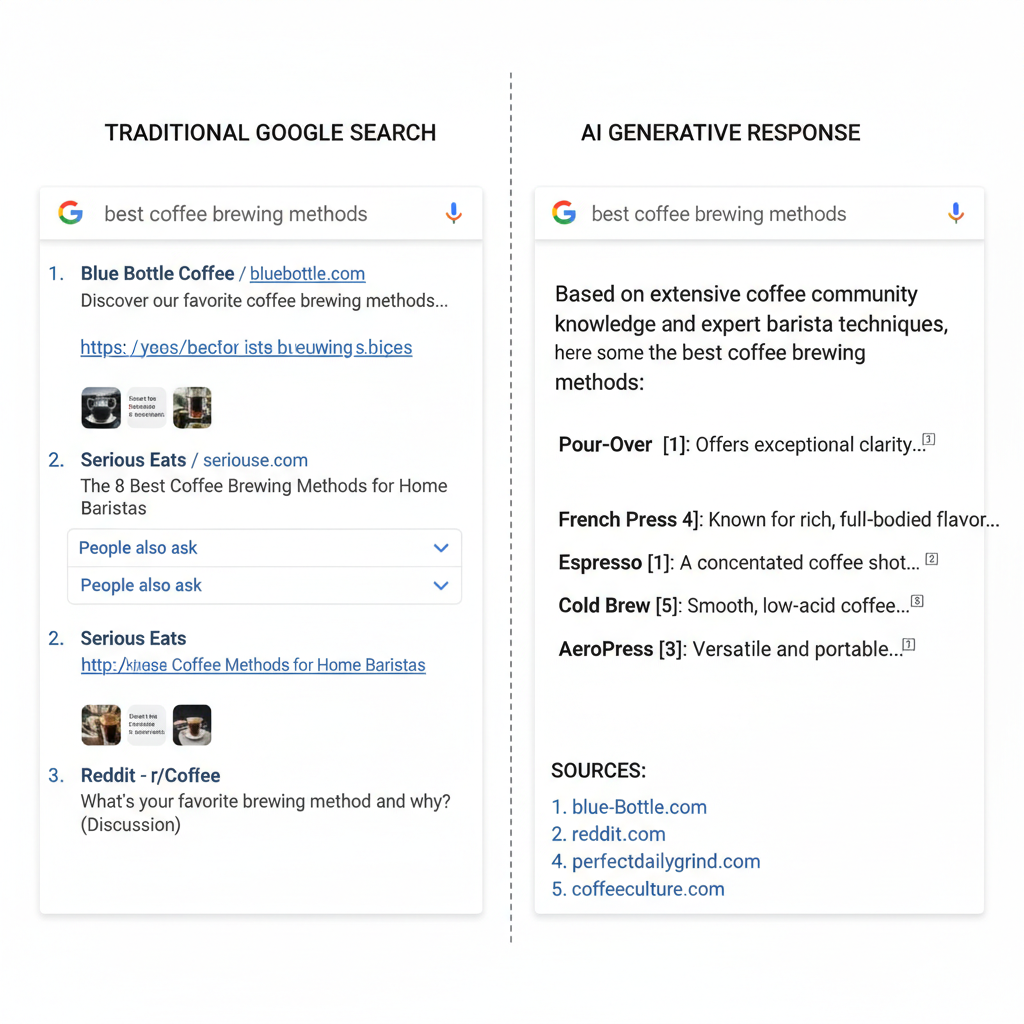
    Comparison of traditional SERPs and modern Generative Engine Optimization results.
    A comparison of traditional search engine results pages and the modern generative engine optimization landscape.

    The strategic imperative for SMEs is clear: failing to be cited in an AI summary means being invisible to 40% of the active user base. AI agents do not “surf” the web like humans; they ingest structured data and verifiable entities. To stay relevant, businesses must move from manual tinkering to a systemic approach that provides the high-quality data inputs these agents require.

    Technical SEO for AI Agents: Chunking and Semantic Clarity

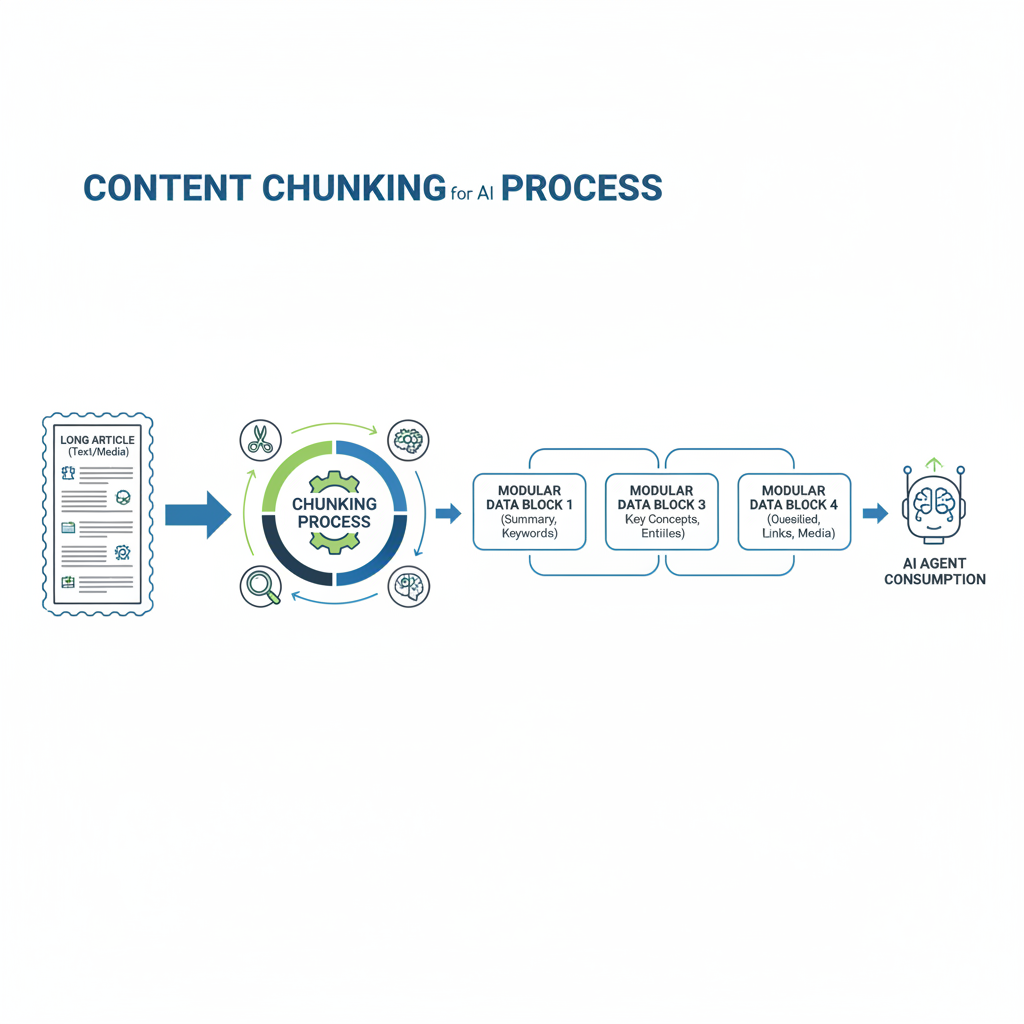
    Content chunking is the process of breaking long-form articles into modular, semantic fragments that AI bots can easily parse. In the current search landscape, treating a blog post as a single wall of text is a technical liability. Instead, content must be structured using explicit Schema.org entity connections and delivered via Server-Side Rendering (SSR) to ensure it is immediately available for ingestion by search bots.

    Visual representation of content chunking for AI agent ingestion.
    Visual representation of modular content chunking designed for AI agent ingestion.
    Feature Human-Readable Content Agent-Ingestible Data
    Structure Narrative flow and storytelling Modular “chunks” and entities
    Hierarchy Visual H1-H4 headings Nested JSON-LD and Schema
    Loading Client-side aesthetics Server-Side Rendering (SSR)
    Primary Goal Engagement and time-on-page Citation frequency and accuracy

    Semantic clarity ensures that the relationship between different topics on your site is unmistakable. While humans enjoy a rhythmic narrative, AI agents prioritize the extraction of specific facts. By implementing modern frameworks like Next.js or ensuring your low-code CMS outputs clean data, you provide the clarity needed for agentic search engines to trust and cite your expertise.

    Automating Search Everywhere: From Manual Chaos to Systemic Visibility

    Low-code automation using tools like n8n has become the only sustainable way for smaller organizations to compete with enterprise resources. By creating workflows that automatically sync insights from a core article to LinkedIn, TikTok, and other social channels, businesses can maintain a multi-platform presence without constant manual labor. This approach transforms a single piece of content into a distributed visibility network.

    Two people typing on RGB keyboards with code on screens, indicating a cybersecurity environment.
    Automation and technical workflows allow for systemic visibility across multiple platforms.

    Modern automation systems now include SERP monitoring triggers that detect changes in citation patterns. When an AI summary drops a brand’s reference, the system can alert the content team or trigger an automated update to the page’s metadata and Schema. This move from manual chaos to a working system allows teams to spend less time on administration and more on strategic decision-making.

    Why Technical Foundations Matter More Than Ever

    Information architecture remains the silent driver of success in an AI-dominated search market. Even the most advanced AI models struggle with poorly rendered sites or broken internal link structures. A robust technical foundation ensures that crawl budgets are spent on high-value pages, and that the data presented is authoritative and easy to index.

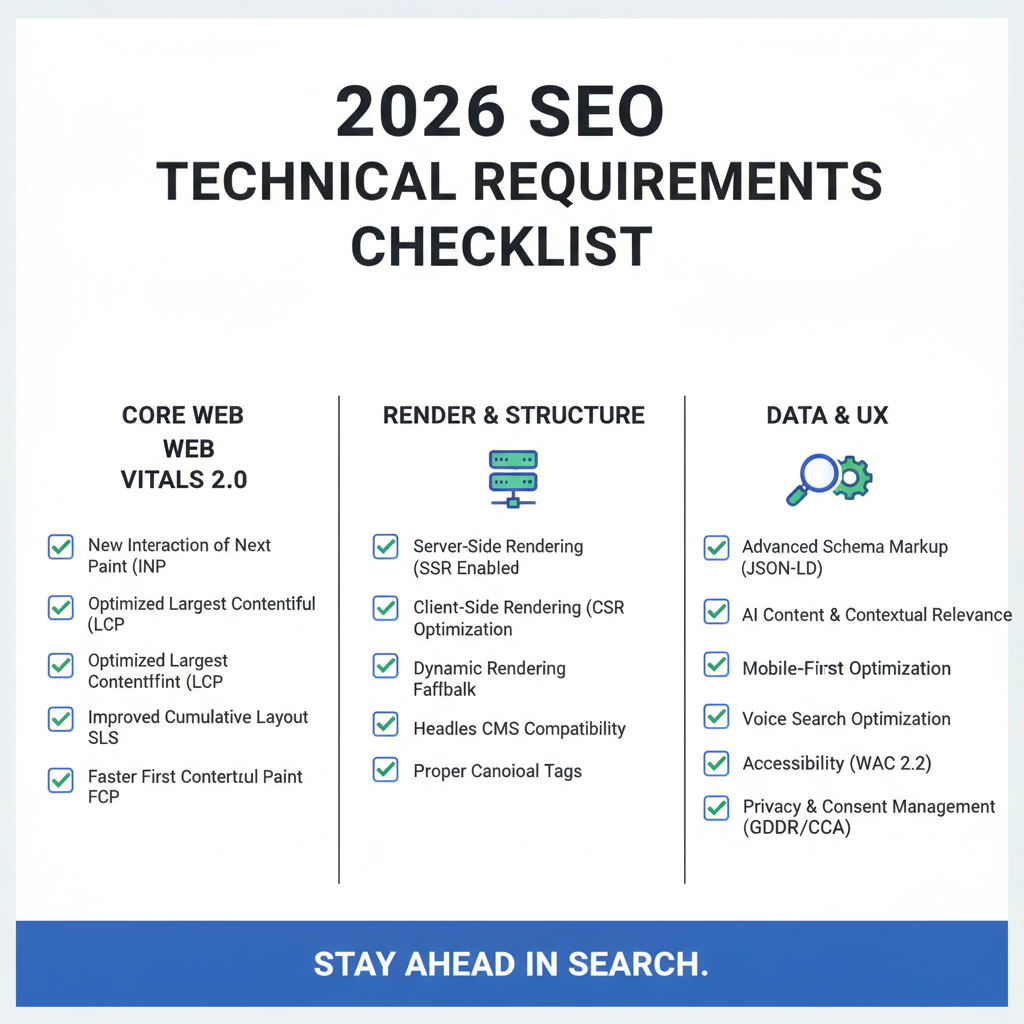
    2026 Technical SEO compliance checklist.
    Essential technical compliance checklist for modern search engines.

    Technical hygiene is a continuous requirement, not a one-time task. Sites that prioritize high-quality rendering and structured data are cited more frequently because they reduce the computational effort required for search engines to understand their content. This efficiency translates directly into better visibility and more frequent citations in AI responses.

    From Manual Chaos to Working Systems

    Auditing current workflows is the essential starting point for reclaiming operational efficiency. Many marketing departments are still trapped in the manual labor of generating meta-descriptions, updating internal links, and cross-posting content. These repetitive tasks are prime candidates for low-code automation, allowing your staff to focus on high-level content strategy rather than routine maintenance.

    By identifying these friction points, you can implement n8n-based systems that handle the data heavy-lifting. The transition from a chaotic manual process to a structured visibility system is the hallmark of a resilient business in 2026. This systematic approach ensures that every piece of content created is optimized for both the human reader and the AI agents that now gatekeep the search results.

    Frequently Asked Questions

    What is the difference between SEO and GEO?

    Traditional SEO aims to rank a website in a list of results, while Generative Engine Optimization (GEO) focuses on being included as a cited source within an AI-generated answer.

    Is content chunking necessary for smaller websites?

    Yes. AI agents process information more effectively when it is modular. Regardless of site size, clear structure helps agents parse and cite your specific information accurately.

    How does automation help with search visibility?

    Automation allows for real-time updates to technical data, such as Schema and metadata, and ensures that content is consistently distributed across multiple platforms without manual effort.

    Do we still need human-centric content in 2026?

    Human-centric value remains critical. AI agents look for unique insights and expertise to include in their summaries, which can only be provided by skilled human creators.

    Your next move

    The landscape of search has changed, but the opportunity for growth remains significant for those who adapt. Moving from manual tinkering to a structured, automated system is the most effective way to ensure your brand survives and thrives in the era of GEO. Review your existing content pipeline and identify one repetitive task-such as internal linking or cross-platform syncing-to automate this week.

    By establishing a technical foundation based on semantic clarity and modular data, you position your brand to be cited by the very AI agents that users now rely on. Start building your automated visibility system today to move from manual chaos to a reliable, working engine.

  • SEO in 2026: The Strategic Shift to Automated Authority

    Key Takeaways

    • Search is shifting from a list of blue links to synthesized generative answers that cite high-integrity data.
    • Manual SEO workflows are becoming a bottleneck as search algorithms transition to weekly iteration cycles.
    • n8n and low-code tools allow small to medium-sized businesses to maintain visibility by automating content clusters and internal linking.
    • E-E-A-T must be automated to prove authority at the speed required by large language models (LLMs).
    • Structured data and Schema.org act as the essential API for modern search engine visibility.

    Beyond the Click: The Rise of Generative Engine Optimization (GEO)

    Generative Engine Optimization (GEO) represents the fundamental shift from ranking for clicks to ranking for citations. In the 2026 landscape, AI overviews and Search Generative Experiences (SGE) dominate the top of the search results funnel, providing direct answers rather than a directory of websites. This means visibility is now measured by your presence within synthesized results rather than traditional click-through rates.

    Visual representation of Generative Engine Optimization (GEO) workflow.
    Visual representation of Generative Engine Optimization (GEO) workflow. Credit: Generated by Articfly AI

    Content must be architected specifically for LLM consumption to earn these critical citations. These models prioritize high-integrity data that can be easily parsed and verified. If your content is not structured for these generative engines, your brand becomes invisible in the primary interface where users now seek information.

    The success metric for 2026 is the micro-conversion of being quoted. When an AI cites your specific data point or expert opinion, it reinforces your authority across the entire knowledge graph. This shift requires a move away from generic blogging toward data-dense, structured contributions.

    The Scalability Crisis: Why Manual Workflows Fail in 2026

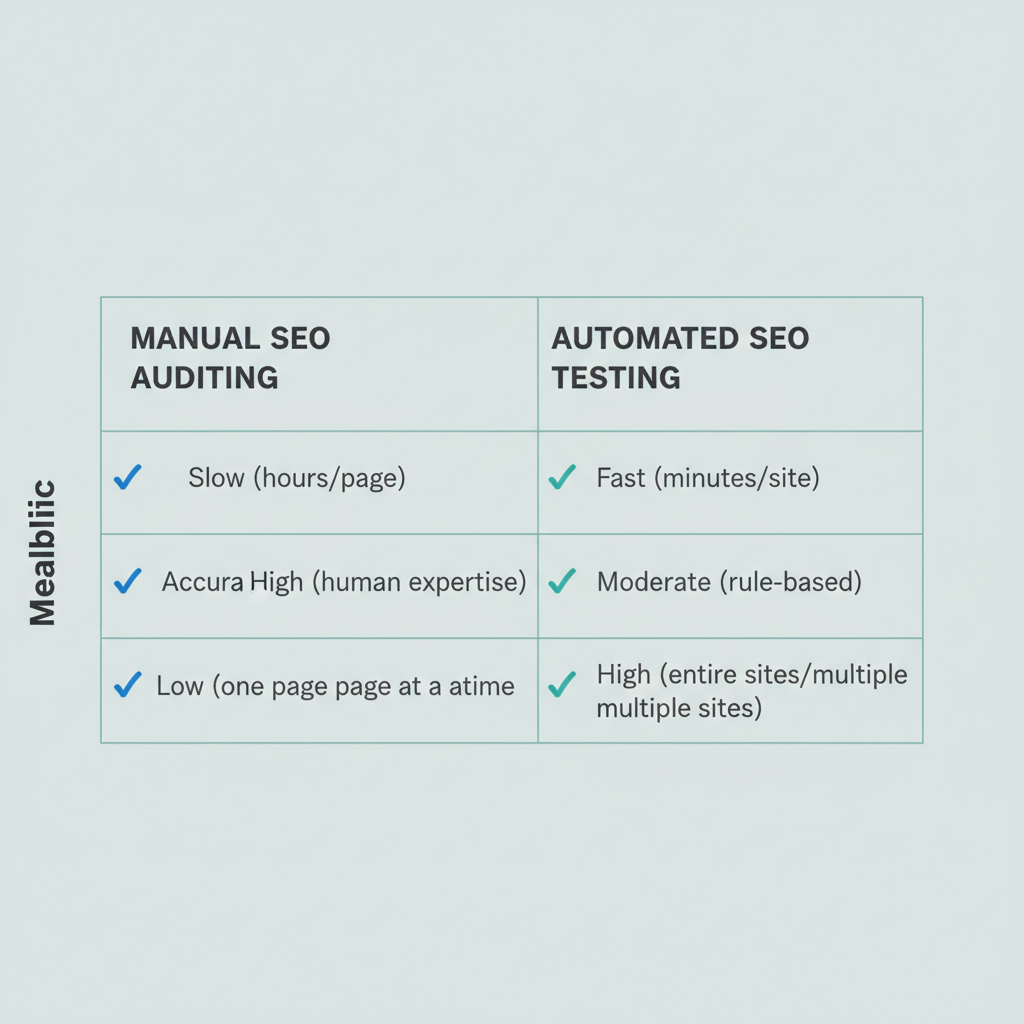
    Manual content auditing has become a significant liability in an era where search algorithms iterate on a weekly basis. Traditional SEO strategies relied on quarterly or biannual updates, but the speed of generative engine updates makes this pace obsolete. Relying on human editors to manually track every change in keyword intent or ranking factor creates a “manual chaos” bottleneck.

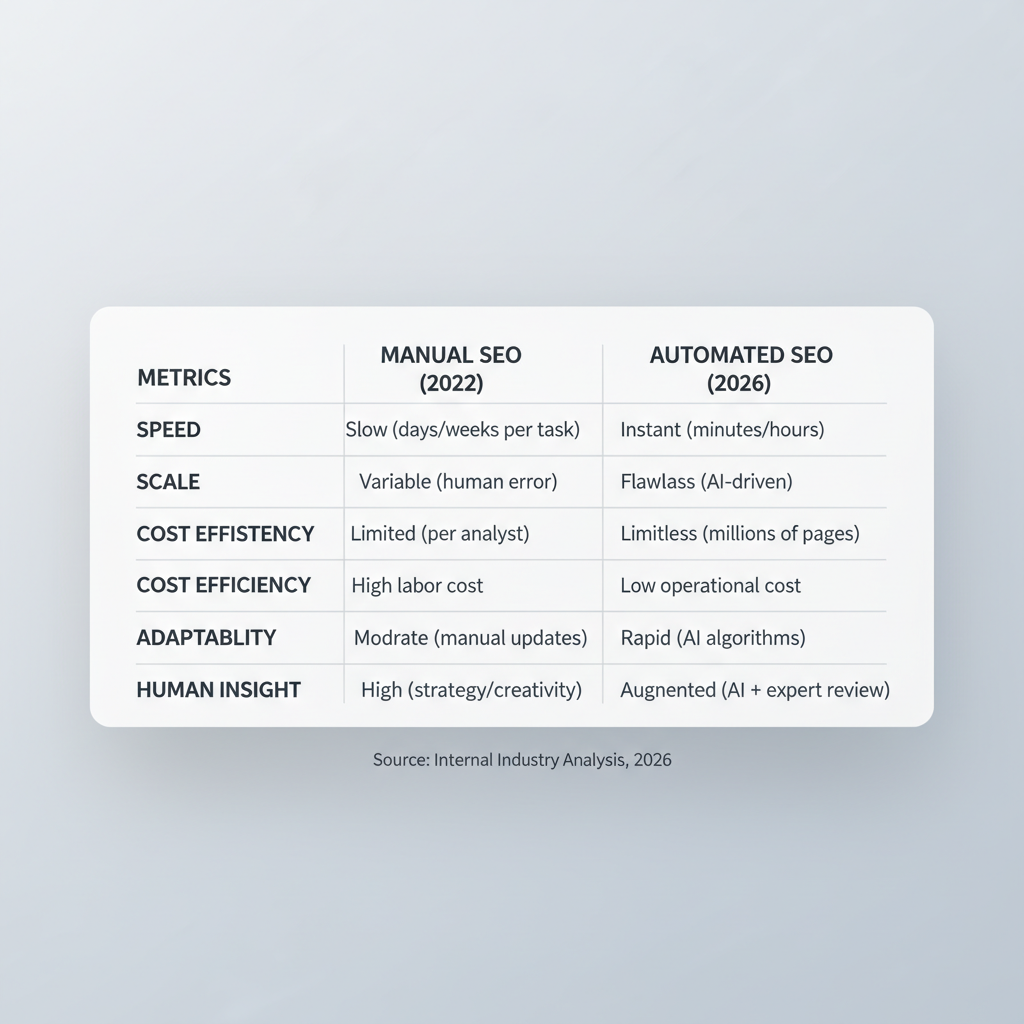
    Comparison table between manual and automated SEO strategies.
    Comparison table between manual and automated SEO strategies. Credit: Generated by Articfly AI

    The cost-per-page for manual production is no longer sustainable for SMEs looking to compete with larger enterprises. While a human-only team might take weeks to research and publish a content cluster, automated systems can deploy high-quality, verified content in hours. This velocity is not about volume for the sake of volume; it is about keeping pace with the real-time requirements of search engines.

    Feature Manual SEO Workflow Automated SEO Engine
    Update Frequency Quarterly / Monthly Near Real-Time / Weekly
    Time-to-Market 7-14 Days per article < 24 Hours for a cluster
    Scalability Limited by headcount Limited by server capacity
    Error Rate High (Human oversight) Low (Systemic validation)

    Maintaining a competitive edge requires a shift in mindset from “content drafting” to “system architecture.” By automating the repetitive elements of SEO, businesses can reallocate human creativity to high-level strategy and unique insight. The gap between those using manual processes and those using automated systems is widening rapidly.

    Building the “Search Everywhere” Engine with n8n and Low-Code

    Automating the distribution of content across multiple platforms is the core of a “Search Everywhere” strategy. Using n8n, businesses can create sophisticated workflows that handle internal linking, content clustering, and cross-platform syncing simultaneously. This ensures that a single piece of verified insight is reflected on your blog, social media channels, and business directories without manual intervention.

    A high-tech command center with illuminated digital screens in a futuristic setting.
    A high-tech command center with illuminated digital screens in a futuristic setting. Credit: Photo Keysi Estrada from Pexels

    Low-code tools provide the flexibility to build custom SEO engines that fit specific business needs. Instead of relying on generic plugins, n8n allows for the creation of precise data pipelines that monitor ranking changes and trigger content refreshes automatically. This systematic approach transforms SEO from a guessing game into a predictable business process.

    5-Step Checklist for Automated SEO Workflows
    1. Connect your primary data source (CMS) to n8n via API.
    2. Set up automated monitoring for target topic performance.
    3. Build a content refresh trigger for declining citations.
    4. Automate structured data (Schema.org) injection for every new post.
    5. Sync blog updates to social media and business profiles automatically.

    Internal linking is another area where automation provides a strategic advantage. Instead of manually searching for relevant old posts to link to new content, an automated system can scan your entire library and place relevant, context-aware links instantly. This improves site structure and helps search crawlers understand the relationship between your topics more effectively.

    Automating E-E-A-T: Proving Authority at Machine Speed

    Scaling authority signals like Experience, Expertise, Authoritativeness, and Trustworthiness (E-E-A-T) is the most challenging hurdle for manual teams. Generative engines look for proof of real-world experience, such as case studies and verified results, to validate their citations. Automation can be used to sync these real-world data points directly into your content library, ensuring your expertise is always documented.

    Businesswoman in formal attire thinking beside a window with a tablet.
    Businesswoman in formal attire thinking beside a window with a tablet. Credit: Photo Andrea Piacquadio from Pexels

    Structured data serves as the “API for SEO,” allowing you to feed search engines the specific details they need to trust your content. By automating the generation of Schema.org markup, you provide a clear roadmap of your authors’ credentials and the validity of your claims. This machine-readable proof is often what separates a cited expert from a generic source.

    Consistency across the web is also critical for establishing author signatures. Automated workflows can ensure that every time an expert from your company publishes content, their bio, social proof, and professional credentials are perfectly aligned across every platform. This consistency signals to AI models that the information is coming from a reliable, verified source.

    FAQ

    What is the difference between SEO and GEO?

    SEO focuses on ranking websites in a list of results for humans to click. GEO (Generative Engine Optimization) focuses on getting your content cited as a source within an AI-generated answer.

    Can I still rank without automation in 2026?

    It is possible for very niche or low-competition topics, but for competitive markets, the speed and volume required to keep up with weekly algorithm updates make manual work unsustainable.

    How does n8n help with search rankings?

    n8n automates the technical “plumbing” of SEO, such as internal linking, content distribution, and metadata updates, allowing your site to maintain higher technical integrity and authority signals at scale.

    Is high content velocity considered “spam” by 2026 standards?

    Velocity is only considered spam if the quality is low. High-velocity systems that produce verified, data-backed, and well-structured content are viewed as authoritative and helpful by generative engines.

    Put this into practice

    The transition from manual chaos to a systemic SEO engine begins with identifying your most time-consuming bottlenecks. For many SMEs, this is either the manual distribution of content or the constant need to update old blog posts. Rather than attempting to automate your entire marketing department at once, focus on a single high-impact workflow.

    Audit your current manual tasks and identify one specific SEO process to automate using n8n this quarter. Whether it is automating your internal linking or syncing your case studies to your blog, creating a structured system is the only way to ensure visibility in the generative era. Moving toward an automated framework today will provide the strategic advantage necessary to remain competitive in 2026 and beyond.

  • Scalable SEO Testing: Automating Validation Workflows

    Key Takeaways

    • Automated SEO testing reduces human error and provides real-time performance insights.
    • Strategic validation focuses on technical integrity, semantic relevance, and SERP volatility.
    • n8n serves as a powerful orchestrator for connecting SEO tools into a unified testing suite.
    • Meaningful SEO A/B testing requires a structured hypothesis and isolated variables.

    The Strategic Imperative of Automated SEO Testing

    Comparison table between manual and automated SEO testing processes.
    Comparison table between manual and automated SEO testing processes.

    Transitioning from reactive audits to proactive validation is a fundamental shift required for modern digital scaling. Manual SEO checks are inherently prone to human error and often fail to capture the high-frequency changes occurring across large-scale web properties. By architecting an automated testing environment, businesses move from a defensive posture to a strategic one, ensuring that search visibility is maintained through systematic rigor rather than periodic intervention.

    Feature Manual SEO Testing Automated SEO Testing
    Scalability Limited by human hours Virtually infinite across thousands of URLs
    Frequency Monthly or quarterly audits Continuous, real-time monitoring
    Accuracy High risk of oversight Precision-driven based on logic rules
    Response Time Delayed (Post-incident) Immediate alerts upon deviation

    Foundational Pillars: What to Test in an Automated Workflow

    Defining the specific variables for monitoring is the first step in creating a reliable validation system. Automation should not merely collect data; it must validate specific hypotheses regarding technical health and content performance. A sophisticated workflow addresses three core pillars to maintain competitive parity in shifting search landscapes.

    Technical Integrity and Crawlability

    A detailed view of a blue lit computer server rack in a data center showcasing technology and hardware.
    A detailed view of a blue lit computer server rack in a data center showcasing technology and hardware.

    Maintaining technical health at scale requires a system capable of monitoring status codes, schema markup validity, and Core Web Vitals in real time. Even minor changes to a site architecture can inadvertently block search crawlers or degrade page speed metrics, leading to rapid ranking declines. Automated scripts can verify that every high-priority page remains indexable and that structured data remains compliant with current schema standards.

    On-Page Semantic Relevance

    Utilizing AI-driven analysis ensures that content remains aligned with evolving search intent and keyword clusters. Search engines frequently refine their understanding of semantic relationships, meaning a page that was once perfectly optimized may lose its relevance over time. Automated workflows can compare existing content against top-performing competitors, identifying gaps in topics or keyword density that require professional adjustment.

    Performance Benchmarking

    Tracking rank volatility and click-through rates relative to specific site changes provides the data necessary for strategic decision-making. By connecting performance metrics directly to a testing database, businesses can correlate updates-such as metadata changes or internal linking adjustments-with actual movement in the search results. This continuous feedback loop transforms raw search data into actionable business intelligence.

    Architecting the Test Environment with n8n

    Flowchart illustrating an automated SEO testing workflow using n8n.
    Flowchart illustrating an automated SEO testing workflow using n8n.

    Leveraging n8n as a central orchestrator enables the integration of various SEO APIs, including Ahrefs, SEMrush, and Google Search Console, into a unified workflow. This low-code approach allows for the creation of complex logic paths that do not require extensive traditional programming. For instance, a workflow can be designed to trigger a full technical audit if a primary keyword drops by more than three positions in a single day.

    Beyond data collection, n8n excels at routing intelligence to the appropriate stakeholders. When the system detects an anomaly-such as a sudden surge in 404 errors or a loss of rich snippet features-it can automatically generate a ticket in a project management tool or send a prioritized alert to a Slack channel. This ensures that technical debt does not accumulate and that critical issues are resolved before they impact organic traffic revenue.

    From Hypothesis to Data: The SEO A/B Testing Framework

    Visual representation of SEO A/B testing variations.
    Visual representation of SEO A/B testing variations.

    Executing controlled experiments is the only way to validate which changes actually drive performance gains. Unlike traditional A/B testing, SEO experiments require the selection of “twin” pages-groups of pages with similar historical traffic and intent. One group serves as the control while the other receives the modification, such as a new header structure or updated meta descriptions.

    The success of this framework depends on isolating variables to ensure that changes in performance can be attributed to the specific update. Automation manages this process by monitoring both groups simultaneously and calculating statistical significance. This scientific approach removes the guesswork from SEO strategy, allowing marketing directors to deploy successful changes across the entire site with confidence.

    Common Pitfalls in Programmatic SEO Validation

    Checklist of common mistakes in automated SEO validation.
    Checklist of common mistakes in automated SEO validation.

    Avoiding over-automation without human oversight is critical for maintaining the integrity of an SEO system. While machines excel at data processing and anomaly detection, they lack the nuanced understanding of brand voice and long-term strategic goals. Relying entirely on automated reports without professional interpretation can lead to a focus on “vanity metrics” rather than high-value conversions.

    FAQ

    How often should automated SEO tests run?

    Critical technical health checks, such as status code monitoring and crawlability audits, should run daily or even hourly for high-traffic sites. Ranking and semantic relevance checks are typically more effective when run on a weekly basis to account for standard SERP volatility.

    Do I need extensive coding knowledge to use n8n for SEO?

    No, n8n is a low-code platform that utilizes a visual node-based interface. While a basic understanding of JSON and API structures is helpful, the platform is designed to allow business professionals to build complex automations without writing traditional code.

    Can automation replace a professional SEO audit?

    Automation enhances the auditing process by handling the repetitive data collection and monitoring tasks. However, it does not replace the need for a professional strategist to interpret the data, identify complex patterns, and set the overarching creative direction.

    What are the most critical KPIs to monitor in an automated system?

    The most vital indicators include crawl error rates, Core Web Vitals performance, keyword ranking distribution, and organic click-through rate. Monitoring these ensures both the technical accessibility and the competitive relevance of your content.

    The Path Toward Algorithmic Efficiency

    Auditing your current manual processes is the necessary precursor to implementing a high-performance automation suite. Identify the specific SEO tasks that consume the most internal resources or are most susceptible to human error, and target these as the first candidates for automation. By systematically replacing manual chaos with structured workflows, you build a scalable foundation that adapts to the complexities of search algorithms in real time.

  • Why Anime Aesthetics Are Strategically Sound for Brands

    Key Takeaways

    Strategic differentiation through specialized aesthetics allows small and medium-sized businesses to cultivate a distinct market presence that resonates with modern digital audiences. By moving beyond generic corporate visuals toward high-engagement niche styles-such as anime-inspired branding-organizations can signal cultural relevance and forward-thinking innovation. Efficiency in this transition is achieved through the technical orchestration of tools like n8n and Stable Diffusion, which transform high-cost manual production into scalable automated workflows.

    • Niche aesthetics are strategic assets that drive higher engagement in the creator economy.
    • Workflow automation via n8n is essential to mitigate the high cost and time requirements of complex visual production.
    • Maintaining a “human-in-the-loop” approach ensures that automated outputs remain aligned with brand standards and professional quality.
    • Scaling visual branding requires a transition from manual chaos to structured, low-code systems.

    The Aesthetic Shift: Why Niche Visuals are the New Professional Standard

    Digital artwork on a tablet with stylus and glasses in a creative setting.
    Photo Kevin Williams from Pexels

    The adoption of niche visual languages represents a significant evolution in digital communication, where visual personality now serves as a primary marker of brand authority. In a saturated content landscape, traditional corporate imagery often fails to capture the attention of sophisticated consumers. Adopting specialized aesthetics, including anime-inspired designs, is no longer limited to subcultural niches but is recognized as a professional strategic choice that signals a brand is attuned to current cultural movements.

    For a modern enterprise, the assertion that anime-inspired visuals are acceptable in a professional context is grounded in the psychological shift toward visual storytelling. This aesthetic choice offers a level of dynamism and emotional resonance that static stock photography cannot replicate. By embracing these styles, a business demonstrates its ability to adapt to the preferences of a demographic that values creativity and high-fidelity visual narratives.

    However, the transition to such a distinct visual identity involves inherent operational challenges. The manual creation of detailed, stylized artwork is both time-intensive and expensive. Without a robust system to manage production, the pursuit of a niche aesthetic can lead to significant bottlenecks in the content calendar. Strategic success, therefore, depends on the ability to institutionalize the production process through automation.

    De-risking Brand Personality: A Strategic Assessment

    Strategic alignment between brand identity and aesthetic choice is a prerequisite for any significant shift in visual direction. Before a business commits to a niche aesthetic, it must evaluate whether the proposed visual language complements its core mission and resonates with its target audience. This diagnostic process reduces the risk of brand dissonance and ensures that the visual identity serves as an authentic extension of the company’s voice.

    A structured assessment helps determine if your brand is ready to integrate anime-inspired or other high-engagement niche visuals into its marketing mix. Consider the following criteria to evaluate brand fit:

    Assessment Category Ideal Indicator Strategic Risk
    Target Audience Tech-savvy, values innovation and creativity. Alienation of conservative, legacy-focused demographics.
    Brand Tone Forward-looking, energetic, and storytelling-driven. Inconsistency with purely clinical or austere brand voices.
    Industry Position Disruptor or specialized service provider. Potential friction in highly regulated or traditional sectors.

    Once the decision is made to proceed, the focus must shift from conceptual design to operational execution. The primary barrier for most organizations is not the lack of creative vision, but the absence of a repeatable system to generate high-quality assets. This is where the application of low-code automation becomes a decisive factor in maintaining brand consistency without exhausting internal resources.

    Building the Pipeline: Automating Anime-Inspired Visual Production with n8n

    A technical diagram of an n8n automation workflow for content creation.
    Generated by Articfly AI

    The technical orchestration of generative assets through n8n provides a level of control and scalability that basic scheduling tools cannot provide. By utilizing n8n as the central nervous system of a content workflow, businesses can connect disparate technologies-such as Stable Diffusion for image generation and Airtable for asset management-into a cohesive, automated pipeline. This architecture allows for the rapid transformation of a creative brief into a finalized visual asset.

    Unlike standard automation platforms, n8n offers the flexibility to handle complex conditional logic and multi-step processes required for high-fidelity visual production. A typical automated pipeline involves several key stages:

    • Input Trigger: A new content brief is logged in a database like Airtable.
    • Prompt Engineering: The system automatically formats a detailed prompt based on brand-specific parameters.
    • Image Generation: n8n sends the prompt to a specialized AI model, such as Stable Diffusion, configured with specific artistic styles.
    • Asset Storage: Generated images are returned and stored in a central repository for review.
    • Notification: The creative team is notified that a new asset is ready for quality control.

    Implementing such a system reduces the manual labor traditionally associated with graphic design. It enables the production of unique, stylized visuals at a fraction of the time and cost, allowing the marketing team to focus on high-level strategy rather than repetitive production tasks. The result is a robust system that transforms creative concepts into tangible assets with minimal friction.

    Operational Precision: Human-in-the-Loop Quality Control

    Close-up of a business professional using a computer mouse and keyboard in a modern office environment.
    Photo iram shehzad from Pexels

    Maintaining operational precision in an automated workflow requires a strategic balance between algorithmic output and human oversight. While AI models can generate impressive visuals, they are not immune to producing generic or off-brand artifacts. A “human-in-the-loop” checkpoint within the n8n workflow ensures that every asset published meets the professional standards of the organization and adheres to the established brand guidelines.

    “The true value of automation is not the total removal of the human element, but the empowerment of individuals to focus exclusively on quality and strategic alignment.” – Lumi Zone Workflow Philosophy

    By inserting a manual approval step before a visual is sent to social media or a blog post, a business can mitigate the risks associated with fully autonomous systems. This checkpoint allows for minor refinements and ensures that the nuance of the brand message is preserved. The workflow remains efficient because the human participant is only required to verify and refine, rather than create from scratch.

    This approach also facilitates continuous improvement of the automation itself. By observing the types of adjustments required during the manual review phase, the technical team can fine-tune the prompts and parameters within the n8n workflow. This iterative process leads to higher-quality initial outputs over time, further reducing the labor required for each asset and increasing the overall throughput of the content engine.

    Scaling Without Friction: From Single Post to Global Campaign

    A conceptual image representing the scalability of automated business systems.
    Generated by Articfly AI

    Achieving scalability within a visual branding strategy is fundamentally a matter of reducing the cost-per-asset through system optimization. When a business relies on manual production, scaling from a single weekly post to a global multi-channel campaign results in a linear increase in costs and labor. Automation via n8n breaks this correlation, allowing an organization to exponentially increase its content volume without a corresponding increase in overhead.

    The return on investment for such systems is evident when comparing traditional design timelines to automated pipelines. A process that once took hours of coordination and manual artistry can be condensed into a workflow that requires only minutes of human intervention. This efficiency enables small to medium-sized businesses to compete with much larger agencies by producing a volume of high-quality, specialized content that was previously cost-prohibitive.

    Furthermore, an automated infrastructure provides the agility necessary to respond to market trends in real-time. If a specific visual style or topic gains traction, the system can be quickly adjusted to produce relevant assets, ensuring the brand remains at the forefront of the conversation. This level of operational flexibility is a significant competitive advantage in the rapidly evolving digital economy.

    FAQ

    Is anime-inspired branding appropriate for a professional business context?

    Yes. When executed with high fidelity and strategic intent, anime-inspired aesthetics signal cultural relevance and a modern, storytelling-driven approach. This style is particularly effective for brands targeting forward-thinking and creative demographics.

    How does n8n differ from standard social media scheduling tools?

    Standard scheduling tools only handle the final step of the process-posting. n8n serves as a complete orchestration layer that can trigger image generation, manage asset databases, and handle complex logic to automate the entire production cycle from brief to publication.

    Does an automated visual pipeline replace the need for a graphic designer?

    Automation does not replace the need for creative expertise; rather, it shifts the designer’s role from manual execution to strategic oversight and quality control. This allows creative professionals to produce more high-level work in less time.

    What tools are required to build this type of automation?

    The core components typically include n8n for workflow orchestration, an AI model like Stable Diffusion for visual generation, and a database or project management tool like Airtable to manage content briefs and assets.

    Transform Your Visual Workflow with Lumi Zone

    Moving from manual visual production to an automated, scalable system is the most effective way to establish a dominant brand presence in the modern digital landscape. By integrating sophisticated automation with a unique aesthetic identity, you can eliminate operational friction and focus on growing your business. Lumi Zone specializes in building these precise, high-efficiency systems using n8n and low-code tools to transform your creative chaos into a structured engine for growth. Prepare your brand for the next level of visual storytelling by implementing a robust automation strategy today.

  • 2026 Exec Playbook: Justify SEO Investment in AI Market

    2026 Exec Playbook: Justify SEO Investment in AI Market

    Understanding the New AI-Dominated Search Landscape

    Illustration of AI influencing search results
    Photo Google DeepMind from Pexels

    The **search landscape is undergoing a profound transformation**, driven by the rapid evolution of artificial intelligence. AI models, including generative search experiences and large language models, are now fundamentally influencing how search engine results pages (SERPs) are ranked and presented. This shift necessitates a fresh perspective on SEO strategy for executives and marketing leaders.

    This evolving environment moves beyond traditional keyword density, emphasizing a deeper understanding of user intent and semantic relevance. Emerging AI-driven SERP features, such as AI snippets and highly visual answers, are reshaping how users interact with search results. To remain competitive, businesses must adapt their SEO efforts to this AI-centric reality.

    Top 3 AI changes to SEO:

    • AI models directly influence SERP rankings and content synthesis.
    • Emphasis on intent and semantic relevance over exact keyword matches.
    • New SERP features like AI snippets and visual results emerge.

    For more detailed insights, explore our AI and SEO hub article. You can also review an external reputable AI-search overview from searchenginejournal.com AI impact.

    The Business Case for SEO in 2026

    Executive presentation on SEO ROI
    Photo Karola G from Pexels

    Building a **robust business case for SEO investment in 2026** requires aligning SEO goals directly with key organizational objectives. This includes quantifiable targets related to revenue generation, enhancing brand authority, and optimizing customer acquisition costs. SEO’s strategic value must be articulated in terms of its tangible contribution to these corporate priorities.

    In an AI-augmented ecosystem, SEO offers long-term cost efficiency that often surpasses paid media strategies. While paid campaigns provide immediate visibility, SEO builds sustainable organic presence and authority. Underfunding SEO in this new era poses a significant risk of competitive disadvantage, leaving market share vulnerable to more forward-thinking competitors.

    Comparison: SEO vs Paid Media ROI in AI Era

    Feature SEO in AI Era Paid Media in AI Era
    Cost Efficiency Long-term, compounding returns Immediate, continuous spend
    Brand Authority Builds trust and organic reputation Limited direct impact
    Sustainability Durable, resilient to ad fatigue Requires constant optimization
    Adaptation to AI Leverages semantic search, intent AI optimizes targeting, bidding

    To further quantify your investment, utilize our SEO ROI calculator. Industry reports on AI and digital spend, such as those from Gartner, provide additional context on market trends.

    Crafting a Persuasive SEO Investment Proposal

    A **persuasive SEO investment proposal** must start with a compelling executive summary that includes a bold impact statement. This section should immediately grab leadership’s attention by outlining the core benefits and strategic imperatives of the proposed investment. It sets the tone for the entire document and underscores the urgency of action.

    The proposal should feature data-driven forecasts, using safe language like “industry trends suggest” rather than inventing specific numbers. Addressing risk mitigation is also crucial, demonstrating foresight in areas such as AI tool integration and talent upskilling. A clear budget breakdown and timeline will provide the necessary financial and operational transparency for decision-makers.

    Proposal Components Checklist:

    • Executive Summary with Bold Impact Statement
    • Current SEO Landscape Analysis
    • Strategic Objectives and Alignment
    • Data-Driven Forecasts and Expected ROI
    • Risk Mitigation Strategies (AI tool integration, talent upskilling)
    • Detailed Budget Breakdown
    • Implementation Timeline and Milestones
    • Key Performance Indicators (KPIs)
    • Call to Action/Next Steps

    For a foundational guide, consider our proposal template page. Additionally, reputable resources like Harvard Business Review offer insights on building strong business cases.

    Communicating ROI to Leadership

    CEO reviewing SEO KPI dashboard
    Photo Lukas from Pexels

    Effectively **communicating SEO ROI to leadership** demands more than just presenting raw numbers; it requires compelling storytelling. Concepts like visual KPI dashboards can effectively illustrate progress in traffic, conversions, and AI-adjusted rankings. These visual aids transform complex data into easily digestible insights for busy executives.

    Narrative framing is essential, tying SEO outcomes directly to overarching strategic objectives of the business. Using relatable analogies and short, impactful anecdotes can make the data resonate more deeply. This approach helps leadership visualize the real-world impact of SEO investments beyond technical metrics.

    Consider an infographic illustrating KPI flow from initial investment to strategic outcomes, clearly linking SEO activities to business results such as increased market share and customer engagement.

    Explore our KPI dashboard examples for inspiration. A Moz case study on SEO ROI can also provide valuable insights into successful communication strategies.

    Overcoming Common Objections

    Visual metaphor for overcoming SEO objections
    Photo Karola G from Pexels

    When presenting an SEO investment proposal, **anticipating and overcoming common objections** is critical for securing budget approval. A frequent concern is the notion that “AI will replace SEO.” It’s important to clarify that AI acts as an enhancer, providing powerful tools for analysis and content creation, rather than a substitute for strategic SEO expertise.
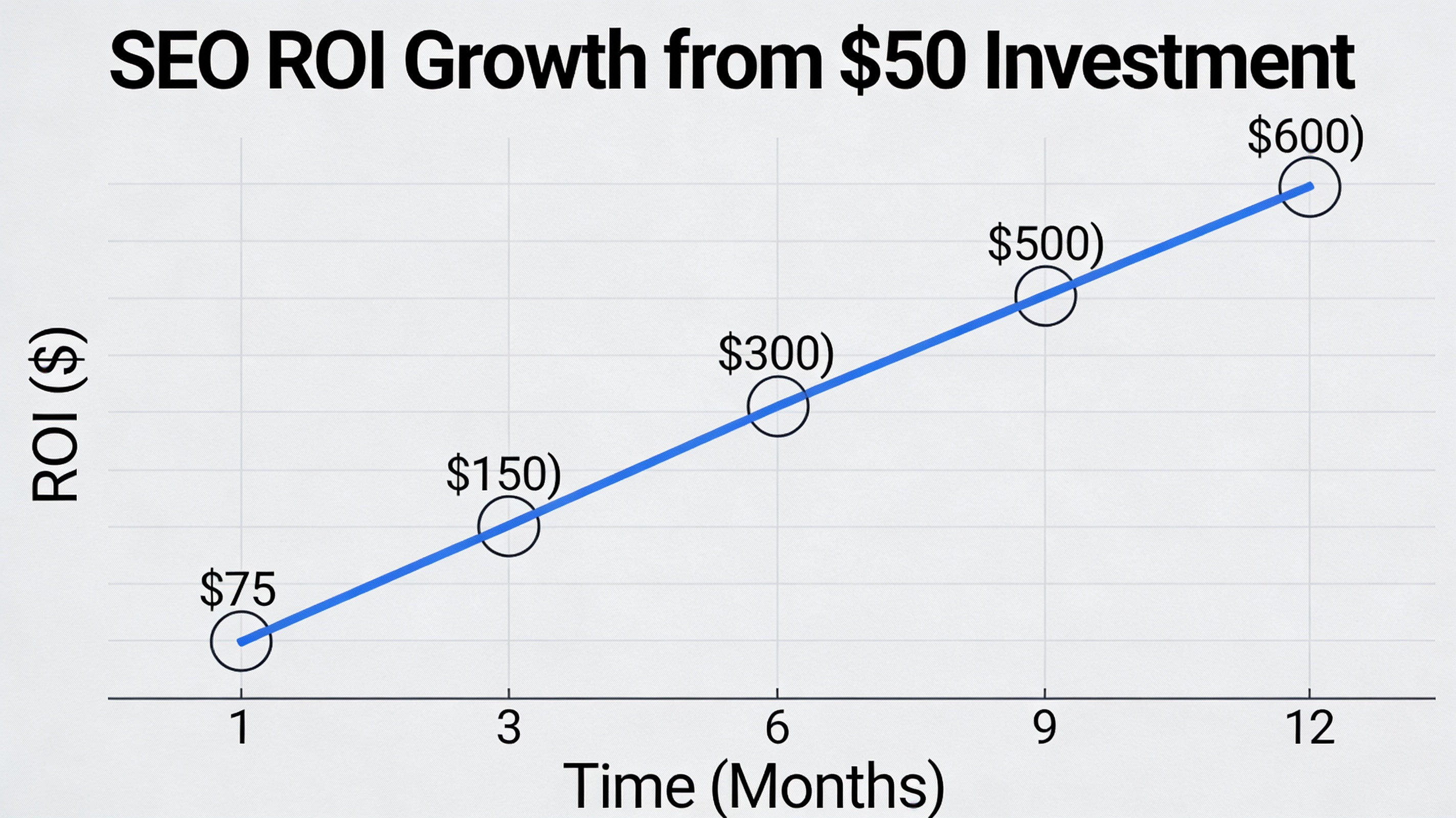
    Another objection, “SEO is too slow,” can be addressed by highlighting how AI-assisted insights can significantly accelerate strategic adjustments and content optimization. For “budget constraints,” propose a phased investment approach, focusing on quick-win tactics that demonstrate early ROI to build confidence for larger allocations. These preemptive rebuttals build trust and demonstrate a comprehensive understanding of the challenges.

    “Investing in SEO today, especially with AI integration, is not just about visibility; it’s about building a digital asset that compounds value. It’s an essential pillar for sustainable growth.”

    Refer to our objection handling guide for more strategies. An article on SEO longevity from Search Engine Land provides further context on the enduring value of SEO.

    Implementation Roadmap and Next Steps

    An **effective implementation roadmap provides a clear 12-month action plan** for your SEO strategy. Outline quarterly milestones, beginning with a comprehensive audit and subsequent AI tool integration. This ensures that the foundational elements are in place before moving to more advanced content revamp and performance tracking initiatives.

    Clearly assign responsibilities to key team members, such as an SEO lead, data analyst, and AI specialist, to ensure accountability. Establish a regular review cadence with leadership to report progress, discuss challenges, and adapt the strategy as needed. This systematic approach ensures sustained momentum and transparent communication.

    12-Month SEO Implementation Timeline:

    • Quarter 1: Foundation & AI Integration
      • Comprehensive SEO Audit
      • AI Tool Selection and Integration
      • Initial Content Strategy Review
    • Quarter 2: Content Optimization & Technical Enhancements
      • AI-Assisted Content Revamp (key pages)
      • Technical SEO Fixes (crawlability, site speed)
      • SERP Feature Optimization
    • Quarter 3: Authority Building & Performance Tracking
      • Link Building Strategy Implementation
      • Advanced Analytics & AI-Driven Reporting
      • User Experience (UX) Enhancements
    • Quarter 4: Scaling & Future Planning
      • Expand AI-Powered Content Creation
      • Explore New AI-Driven Search Opportunities
      • Annual Performance Review & 2027 Planning

    Our roadmap template can help structure your plan. For broader project management insights, consult reputable frameworks such as PMBOK.

    Key Takeaways

    To effectively secure your SEO budget in an AI-dominated market, focus on these core actions:

    • Understand the AI-driven search shift: Adapt to generative search and semantic relevance.
    • Quantify SEO’s business value: Align goals with revenue, brand, and customer acquisition.
    • Craft data-driven proposals: Use forecasts and address risk with AI integration.
    • Communicate ROI effectively: Employ visual KPIs and compelling narratives for leadership.
    • Prepare for objections: Frame AI as an enhancer and present phased investment plans.

    FAQ

    Here are answers to common questions about justifying SEO spend in today’s evolving market:

    How quickly can AI tools show SEO impact?

    AI tools can accelerate certain aspects of SEO, offering quicker insights for content optimization, keyword research, and technical analysis. While immediate ranking changes are rare, AI-driven strategies can lead to noticeable improvements in efficiency and early indicators of performance within weeks to a few months, particularly in content quality and relevance.

    What metrics matter most to the C-suite?

    The C-suite primarily focuses on metrics that directly impact business growth and profitability. Key metrics include return on investment (ROI), customer acquisition cost (CAC) reduction, revenue generated from organic search, brand visibility and authority, and market share growth. Connecting SEO efforts to these high-level business outcomes is crucial.

    Can SEO budget be justified without historic data?

    Yes, it’s possible. Focus on industry benchmarks, competitive analysis, and forward-looking market trends. Highlight the potential opportunity cost of inaction and leverage projected growth based on similar businesses or market size. Emphasize quick-win strategies that can demonstrate early value and build a foundation for future data collection.

    How does AI affect keyword research?

    AI enhances keyword research by moving beyond simple volume to understand user intent, semantic relationships, and conversational queries. AI tools can identify long-tail opportunities, cluster related topics, and predict emerging trends more effectively. This allows for a more nuanced and strategically aligned keyword strategy.

    What’s the safest way to allocate SEO spend in 2026?

    The safest approach involves a phased investment. Start with foundational elements like a technical audit and AI tool integration, followed by strategic content optimization. Prioritize initiatives that offer the highest potential ROI and measurable impact, allowing for adjustments as performance data becomes available. Continuous monitoring and adaptation are key.

    For a detailed breakdown of metrics, consult our detailed metric guide.

    Ready to take action?

    Transform your approach to SEO budgeting and secure the investment your business needs to thrive in an AI-dominated search world. Our comprehensive resources are designed to equip you with everything necessary to make a compelling case.

    Download our free SEO Investment Proposal Template to streamline your planning and presentation. For a personalized strategy discussion, schedule a consultation with our experts. We’re here to help you turn insights into approved budgets and tangible results.

    Download Your Free Proposal Template Schedule a Consultation

  • Low-Cost SEO Strategies That Beat Expensive Campaigns in 2026

    Low-Cost SEO Strategies That Beat Expensive Campaigns in 2026

    Understanding the Real Cost of SEO

    Magnifying glass highlighting SEO costs vs price tags
    Photo Hanna Pad from Pexels

    Debunking myths about expensive SEO is crucial for small businesses and startups. Many believe that competing with high-spend campaigns requires an equally large budget, which is often not the case. This section aims to set realistic expectations by comparing typical agency fees with DIY costs and highlighting the long-term value of sustainable tactics.

    Understanding where money is actually spent in SEO can help identify areas for budget-friendly alternatives. Focus on strategy and consistent effort, rather than simply throwing money at the problem. This playbook will show you how smart decisions can lead to market advantage.

    Common Misconceptions About Pricey Campaigns

    A widespread myth suggests that higher spending guarantees top rankings in search engine results. However, this is a misconception; while budget can provide resources, it does not inherently buy success. Strategy, relevance, and consistent execution ultimately matter more than the sheer volume of investment.

    Many expensive campaigns can underperform if they lack a solid foundation or target irrelevant keywords. Conversely, well-executed, low-cost strategies can yield significant returns by focusing on niche relevance and user intent. The key is intelligent allocation of time and resources, not just capital.

    What Businesses Actually Pay For

    Businesses typically pay for a range of specialized services when investing in SEO. These often include technical audits, comprehensive content creation, and extensive link acquisition efforts. Each of these areas can incur significant costs when outsourced to agencies or specialists.

    However, there are effective ways to cut these expenses without sacrificing quality. Performing your own technical audits, creating content with existing resources, and implementing strategic link-building tactics can drastically reduce your overall spend. The goal is to achieve similar outcomes through smart, internal effort.

    SEO Approach Typical Activities Included Estimated Monthly Cost
    Agency Managed Full technical audits, content strategy & creation, link building outreach, reporting, competitor analysis $500 – $5,000+
    DIY (Self-Managed) Free tool usage (Google Search Console), content repurposing, local citations, basic on-page optimization $0 – $50

    Core Low-Cost SEO Tactics That Deliver Results

    Sticky notes with budget-friendly SEO keywords
    Photo Bruno Bueno from Pexels

    Foundational tactics that any budget can execute are the backbone of effective low-cost SEO. These strategies focus on maximizing your current resources and leveraging free tools to gain a competitive edge. You don’t need a huge budget to make a significant impact on your search rankings.

    From identifying the right keywords to optimizing your website’s pages, these methods are designed for immediate implementation. They prioritize efficiency and measurable results, proving that smart planning can outperform extensive spending. Let’s explore the core tactics that truly deliver.

    Keyword Research on a Budget

    Effective keyword research doesn’t require expensive software subscriptions. You can leverage free tools like Google Trends, AnswerThePublic, and the free tier of Ubersuggest to uncover valuable insights. These platforms help identify trending topics and user queries relevant to your business.

    The key is to focus on long-tail, low-competition terms that your target audience is actively searching for. These specific phrases often have lower search volume but much higher conversion potential. Targeting them allows you to rank more easily and attract highly qualified traffic.

    On-Page Optimization Hacks

    On-page optimization is one of the most impactful low-cost SEO tactics you can implement. Properly optimizing elements like title tags, meta descriptions, and header hierarchy (

    ,

    , etc.) signals to search engines what your content is about. Ensure your primary keywords are naturally included in these areas.

    Further enhance your visibility by implementing structured data snippets using schema.org markup. This helps search engines understand the context of your content, potentially leading to rich snippets in search results. These simple adjustments can significantly improve your click-through rates.

    Technical SEO Basics You Can DIY

    Addressing basic technical SEO issues is crucial for search engine discoverability and can often be done without professional help. Start by regularly checking Google Search Console for any crawl errors that might prevent search engines from accessing your content. Resolving these ensures your pages are properly indexed.

    Another vital step is to ensure your website is mobile-friendly, which you can easily check using Google PageSpeed Insights. A responsive design and fast loading times are non-negotiable for both user experience and search rankings. These simple DIY checks can make a big difference.

    Must-Do Low-Cost SEO Tactics Checklist

    • Utilize Google Trends for keyword discovery.
    • Optimize title tags and meta descriptions with target keywords.
    • Structure content with clear H2, H3, H4 headings.
    • Implement basic schema markup for rich snippets.
    • Monitor Google Search Console for crawl errors.
    • Ensure your website is mobile-friendly and loads quickly.
    • Create or update your Google My Business profile.

    Leveraging Free and Affordable Tools in 2026

    Infographic comparing free and affordable SEO tools in 2026
    Generated by Articfly AI

    The right tools can significantly amplify your low-cost SEO efforts, even without a hefty budget. In 2026, there are more robust free and affordable options than ever before, enabling small businesses to compete effectively. Choosing the correct tools empowers you to streamline processes and gain valuable insights.

    This section will highlight the best current tools that either cost nothing or less than $20 per month. We’ll examine their core functionalities and criteria for selection, ensuring you can make informed decisions. Leveraging these resources efficiently is key to a successful budget-friendly strategy.

    Free Tools

    Many powerful SEO tasks can be accomplished using completely free tools. Google Search Console is indispensable for monitoring your site’s performance in Google Search, identifying indexing issues, and submitting sitemaps. Similarly, Bing Webmaster Tools offers similar functionality for the Bing search engine, providing valuable insights into your site’s visibility.

    For more technical audits, Screaming Frog SEO Spider Lite allows you to crawl up to 500 URLs for free, helping identify broken links, redirect chains, and missing meta descriptions. Mastering these free platforms provides a strong foundation for your SEO initiatives. Top Free SEO Tools 2026 offers more detailed guidance.

    Affordable Paid Tools

    When your budget allows for a small investment, affordable paid tools can offer enhanced features and deeper analysis. Ubersuggest, for instance, provides keyword research, content ideas, and competitor analysis at a low monthly cost. Surfer SEO Lite helps with on-page optimization by suggesting content adjustments based on top-ranking competitors.

    Ahrefs Webmaster Tools, while part of a larger paid suite, offers free access to a limited version that provides site audits and backlink data. Evaluate the cost-benefit of each tool based on your specific needs and budget constraints. Prioritize tools that address your most pressing SEO challenges and offer the highest potential ROI for your minimal spend.

    Choosing the Right Tool for Your Niche

    Selecting the optimal SEO tool depends heavily on your specific business niche and immediate goals. Consider what aspects of SEO you need to prioritize: keyword research, technical audits, content optimization, or backlink analysis. A tool that excels in your weakest area will provide the most value.

    Think of it as a decision-tree: if you’re struggling with keyword ideas, prioritize tools like Ubersuggest or AnswerThePublic. If technical errors are holding you back, Google Search Console and Screaming Frog are essential. Aligning tool capabilities with your strategic needs ensures maximum impact from minimal investment.

    Content Strategies on a Shoestring Budget

    Team brainstorming low-budget content strategies
    Photo Mikhail Nilov from Pexels

    Producing high-impact content without hiring expensive writers is entirely achievable with strategic planning. The key lies in leveraging your existing assets and community resources, along with smart content creation techniques. You don’t need a massive content budget to rank for valuable keywords and attract your target audience.

    This section will guide you through repurposing content, utilizing user-generated contributions, and applying techniques like the skyscraper method. These approaches ensure you maintain a robust content presence while keeping costs minimal. Remember, quality and relevance often trump sheer volume in content marketing.

    Repurposing Existing Assets

    Repurposing existing assets is an incredibly efficient way to generate new content without starting from scratch. Begin by identifying your evergreen content – blog posts, webinars, or PDFs that remain relevant over time. Update these pieces with current data, fresh examples, and enhanced SEO optimization.

    A webinar transcript can become several blog posts, social media snippets, or an infographic. A detailed PDF guide can be broken down into a series of email newsletters. This strategy maximizes the value of content you’ve already invested in, extending its reach and improving its search performance. Repurposing Content for SEO provides further insights.

    User-Generated Content & Community Building

    Harnessing user-generated content (UGC) is a powerful, low-cost strategy for enriching your site and building community. Encourage customers to leave reviews, submit Q&A, or participate in forums related to your products or services. This content is authentic, relevant, and directly addresses customer concerns, which search engines value.

    Additionally, leverage platforms like Reddit and Quora not only to engage with potential customers but also to gather topic ideas. Pay attention to common questions and discussions within your niche, using these insights to inform your content creation. This approach provides valuable, organic content that costs nothing to produce.

    Skyscraper Technique with Limited Resources

    The skyscraper technique can be adapted for limited resources to create high-ranking content. Instead of trying to create the “best” piece of content on a topic from scratch, identify an existing piece of content that performs well but lacks certain elements. Look for low-competition targets with solid but improvable content.

    Your goal is to make it significantly better by adding unique data, fresh perspectives, or compelling visuals that the original piece is missing. You don’t need to reinvent the wheel; just find a way to add substantial, unique value. Search Engine Journal article on the skyscraper technique offers more inspiration.

    Content Type Repurposed Example Brand-New Article Example
    Long-form Guide An old whitepaper on ‘Email Marketing Basics’ updated with 2026 stats and visuals. ‘The Ultimate Guide to AI-Powered Personalization in Email Marketing 2026’.
    Video Content A webinar recording transcribed into a blog post, then split into social media graphics. A professionally filmed interview series with industry leaders on new trends.
    Product Showcase Customer reviews & photos compiled into a ‘User Favorites’ blog post. A dedicated landing page with custom photography and expert-written descriptions for a new product launch.

    Building Authority Without Breaking the Bank

    Networking and guest posting on a shoestring budget
    Photo fauxels from Pexels

    Achieving strong domain authority and building valuable backlinks doesn’t require an enormous budget. Smart link-building and PR tactics can significantly boost your site’s credibility and search rankings for minimal cost. The focus here is on strategic outreach, leveraging existing platforms, and earning media through clever pitching.

    These methods allow small businesses to gain authoritative links and mentions that rival those secured by high-spend campaigns. It’s about being resourceful, providing value, and knowing where to find opportunities. Let’s explore how to build authority effectively and affordably.

    Strategic Outreach and Guest Posting

    Strategic outreach is vital for securing valuable guest posting opportunities and backlinks. Focus your efforts on researching low-authority sites that have high relevance to your niche. These sites are often more receptive to high-quality guest content than larger, more established publications.

    When you reach out, offer value-added content that addresses a specific need or fills a content gap for their audience. Personalized email templates can significantly increase your success rate. Effective Outreach Templates can help you craft compelling messages. Guest posting remains a strong tactic for increasing your domain authority and referral traffic.

    Local Citations and Business Listings

    For local businesses, maintaining consistent NAP (Name, Address, Phone number) information across online directories is paramount. This consistency is a critical signal for local SEO and helps search engines verify your business’s legitimacy. Start by ensuring your Google My Business profile is fully optimized and up-to-date with accurate information and compelling images.

    Beyond Google, leverage niche-specific industry directories and prominent local listing sites. Many of these platforms offer free basic listings that can significantly boost your local search presence. A comprehensive approach to local citations builds trust with both search engines and potential customers.

    Earned Media Through PR Hacks

    Earning media coverage without a PR agency is achievable through creative “PR hacks.” Identify newsworthy angles within your business or industry that could be of interest to journalists and bloggers. This might involve sharing unique data, commenting on a trend, or announcing a local community initiative.

    Platforms like HARO (Help A Reporter Out) connect journalists with expert sources, offering a fantastic opportunity to get featured in major publications for free. Additionally, engaging with micro-influencers in your niche can lead to valuable mentions and backlinks without significant financial outlay. HARO official site provides a direct avenue for these opportunities.

    “We started with a simple email outreach campaign, offering unique insights to local blogs. Within three months, we secured five high-quality backlinks and saw a 15% jump in organic traffic. It proves that personalized value trumps mass emails every time.”

    — A Small Business Owner on Low-Budget Outreach

    Measuring Success and Scaling Up

    Chart illustrating SEO ROI growth from a $50 start
    Generated by Articfly AI

    Equipping yourself with free metrics and a clear growth plan is essential for any low-cost SEO strategy. Understanding how to track your progress allows you to identify what’s working and what isn’t, enabling informed adjustments. You don’t need expensive software to monitor key performance indicators (KPIs).

    This section will guide you through the core metrics to focus on and how to use free tools to visualize your data. We’ll also cover when and how to reinvest any gains to scale your efforts effectively. Measuring success is the first step towards sustainable growth.

    Key Metrics to Track Without Expensive Software

    Tracking core KPIs is straightforward with readily available free tools. Organic traffic, keyword rankings, and click-through rate (CTR) are fundamental indicators of your SEO performance. Google Search Console provides invaluable data on keyword performance, impressions, clicks, and average position for your site.

    Google Analytics, another free tool, allows you to monitor organic traffic volume, user behavior on your site, and conversion rates stemming from organic search. By regularly reviewing these metrics, you can identify trends and pinpoint areas for improvement without any financial investment. SEO KPI Dashboard Template can offer more structure for this.

    When to Reinvest and How to Allocate Budget

    Knowing when to reinvest your profits back into SEO is crucial for sustainable growth. Establish clear thresholds for scaling your spend based on achieved organic traffic, lead generation, or sales increases. Once these milestones are met, consider dedicating a portion of your new revenue to expand your SEO efforts.

    Allocate this newfound budget strategically, focusing on high-ROI tactics that have already proven effective. This might include investing in a premium keyword research tool, subscribing to a content optimization platform, or hiring a freelance content writer for specific high-value pieces. Always prioritize actions that offer the greatest potential for further returns.

    Key Takeaways

    Achieving market advantage with ultra-low-cost SEO is not just possible, it’s a definitive playbook for 2026. Smart strategy consistently trumps big spend when executed effectively.

    Here are seven impactful low-cost actions you can start today to transform your SEO strategy:

    • **Master free keyword tools:** Use Google Trends, AnswerThePublic, and Ubersuggest to find long-tail, low-competition terms.
    • **Optimize on-page elements rigorously:** Perfect your title tags, meta descriptions, and header hierarchy, and add schema markup.
    • **Perform DIY technical audits:** Regularly check Google Search Console for errors and ensure mobile-friendliness with PageSpeed Insights.
    • **Leverage free tools daily:** Integrate Google Search Console and Bing Webmaster Tools into your routine for monitoring and improvements.
    • **Repurpose existing content creatively:** Transform old webinars, PDFs, and blog posts into fresh, SEO-optimized material.
    • **Build authority through strategic outreach:** Focus on guest posting on relevant, accessible sites and using HARO for earned media.
    • **Monitor KPIs with free dashboards:** Track organic traffic, keyword rankings, and CTR using Google Analytics and Search Console to guide your next moves.

    FAQ

    Can $50 really make a difference in SEO?

    Yes, absolutely. While $50 might not cover extensive campaigns, it can fund crucial tools like a month of Ubersuggest’s basic plan or a small advertising boost. More importantly, $50 can be used for training resources or to outsource a very specific, high-impact micro-task, significantly augmenting what you can do with free tools and your own time.

    How long before I see results from low-cost tactics?

    SEO is a long-term strategy, regardless of budget. You can expect to see initial improvements in areas like crawlability and indexing within weeks for technical fixes. For keyword rankings and significant organic traffic growth, it typically takes 3-6 months of consistent effort. Patience and persistence are key.

    Which free tool gives the best backlink data?

    For truly free backlink data, Google Search Console is invaluable for showing links *to your own site*. While it doesn’t show competitor backlinks, it’s essential for understanding your own link profile. Ahrefs Webmaster Tools also offers a powerful free tier for backlink analysis of your verified sites, which is highly recommended for deeper insights.

    Is guest posting still effective in 2026?

    Yes, guest posting remains highly effective in 2026 when done strategically. The focus has shifted from quantity to quality and relevance. Guest posts should offer genuine value to the host site’s audience and come from reputable, relevant sources. It’s about building genuine relationships and authority, not just acquiring links.

    How do I know when to upgrade to paid tools?

    You’ll know it’s time to consider paid tools when your free tools can no longer provide the depth of data or automation you need to scale. This might be when you hit URL limits, require more advanced competitor analysis, or need integrated reporting. Start with a small, specific paid tool that addresses your biggest bottleneck and demonstrates clear ROI before expanding further.

    Next steps for low-cost SEO

    Ready to unlock market advantage with smart, budget-friendly SEO strategies? Your journey to competing with high-spend campaigns starts now.

    Take action today by exploring these essential resources:

    • Download our free “Low-Cost SEO Starter Kit” checklist to begin implementing these tactics immediately.
    • Subscribe for weekly budget SEO tips delivered straight to your inbox, keeping you ahead of the curve.
    • Join our community forum for peer support, shared insights, and answers to your pressing SEO questions.
  • 2026 Exec Playbook: Justify SEO Investment in AI Market

    2026 Exec Playbook: Justify SEO Investment in AI Market

    Understanding the New AI-Dominated Search Landscape

    Illustration of AI influencing search results
    Photo Google DeepMind from Pexels

    The **search landscape is undergoing a profound transformation**, driven by the rapid evolution of artificial intelligence. AI models, including generative search experiences and large language models, are now fundamentally influencing how search engine results pages (SERPs) are ranked and presented. This shift necessitates a fresh perspective on SEO strategy for executives and marketing leaders.

    This evolving environment moves beyond traditional keyword density, emphasizing a deeper understanding of user intent and semantic relevance. Emerging AI-driven SERP features, such as AI snippets and highly visual answers, are reshaping how users interact with search results. To remain competitive, businesses must adapt their SEO efforts to this AI-centric reality.

    Top 3 AI changes to SEO:

    • AI models directly influence SERP rankings and content synthesis.
    • Emphasis on intent and semantic relevance over exact keyword matches.
    • New SERP features like AI snippets and visual results emerge.

    For more detailed insights, explore our AI and SEO hub article. You can also review an external reputable AI-search overview from searchenginejournal.com AI impact.

    The Business Case for SEO in 2026

    Executive presentation on SEO ROI
    Photo Karola G from Pexels

    Building a **robust business case for SEO investment in 2026** requires aligning SEO goals directly with key organizational objectives. This includes quantifiable targets related to revenue generation, enhancing brand authority, and optimizing customer acquisition costs. SEO’s strategic value must be articulated in terms of its tangible contribution to these corporate priorities.

    In an AI-augmented ecosystem, SEO offers long-term cost efficiency that often surpasses paid media strategies. While paid campaigns provide immediate visibility, SEO builds sustainable organic presence and authority. Underfunding SEO in this new era poses a significant risk of competitive disadvantage, leaving market share vulnerable to more forward-thinking competitors.

    Comparison: SEO vs Paid Media ROI in AI Era

    Feature SEO in AI Era Paid Media in AI Era
    Cost Efficiency Long-term, compounding returns Immediate, continuous spend
    Brand Authority Builds trust and organic reputation Limited direct impact
    Sustainability Durable, resilient to ad fatigue Requires constant optimization
    Adaptation to AI Leverages semantic search, intent AI optimizes targeting, bidding

    To further quantify your investment, utilize our SEO ROI calculator. Industry reports on AI and digital spend, such as those from Gartner, provide additional context on market trends.

    Crafting a Persuasive SEO Investment Proposal

    A **persuasive SEO investment proposal** must start with a compelling executive summary that includes a bold impact statement. This section should immediately grab leadership’s attention by outlining the core benefits and strategic imperatives of the proposed investment. It sets the tone for the entire document and underscores the urgency of action.

    The proposal should feature data-driven forecasts, using safe language like “industry trends suggest” rather than inventing specific numbers. Addressing risk mitigation is also crucial, demonstrating foresight in areas such as AI tool integration and talent upskilling. A clear budget breakdown and timeline will provide the necessary financial and operational transparency for decision-makers.

    Proposal Components Checklist:

    • Executive Summary with Bold Impact Statement
    • Current SEO Landscape Analysis
    • Strategic Objectives and Alignment
    • Data-Driven Forecasts and Expected ROI
    • Risk Mitigation Strategies (AI tool integration, talent upskilling)
    • Detailed Budget Breakdown
    • Implementation Timeline and Milestones
    • Key Performance Indicators (KPIs)
    • Call to Action/Next Steps

    For a foundational guide, consider our proposal template page. Additionally, reputable resources like Harvard Business Review offer insights on building strong business cases.

    Communicating ROI to Leadership

    CEO reviewing SEO KPI dashboard
    Photo Lukas from Pexels

    Effectively **communicating SEO ROI to leadership** demands more than just presenting raw numbers; it requires compelling storytelling. Concepts like visual KPI dashboards can effectively illustrate progress in traffic, conversions, and AI-adjusted rankings. These visual aids transform complex data into easily digestible insights for busy executives.

    Narrative framing is essential, tying SEO outcomes directly to overarching strategic objectives of the business. Using relatable analogies and short, impactful anecdotes can make the data resonate more deeply. This approach helps leadership visualize the real-world impact of SEO investments beyond technical metrics.

    Consider an infographic illustrating KPI flow from initial investment to strategic outcomes, clearly linking SEO activities to business results such as increased market share and customer engagement.

    Explore our KPI dashboard examples for inspiration. A Moz case study on SEO ROI can also provide valuable insights into successful communication strategies.

    Overcoming Common Objections

    Visual metaphor for overcoming SEO objections
    Photo Karola G from Pexels

    When presenting an SEO investment proposal, **anticipating and overcoming common objections** is critical for securing budget approval. A frequent concern is the notion that “AI will replace SEO.” It’s important to clarify that AI acts as an enhancer, providing powerful tools for analysis and content creation, rather than a substitute for strategic SEO expertise.

    Another objection, “SEO is too slow,” can be addressed by highlighting how AI-assisted insights can significantly accelerate strategic adjustments and content optimization. For “budget constraints,” propose a phased investment approach, focusing on quick-win tactics that demonstrate early ROI to build confidence for larger allocations. These preemptive rebuttals build trust and demonstrate a comprehensive understanding of the challenges.

    “Investing in SEO today, especially with AI integration, is not just about visibility; it’s about building a digital asset that compounds value. It’s an essential pillar for sustainable growth.”

    Refer to our objection handling guide for more strategies. An article on SEO longevity from Search Engine Land provides further context on the enduring value of SEO.

    Implementation Roadmap and Next Steps

    An **effective implementation roadmap provides a clear 12-month action plan** for your SEO strategy. Outline quarterly milestones, beginning with a comprehensive audit and subsequent AI tool integration. This ensures that the foundational elements are in place before moving to more advanced content revamp and performance tracking initiatives.

    Clearly assign responsibilities to key team members, such as an SEO lead, data analyst, and AI specialist, to ensure accountability. Establish a regular review cadence with leadership to report progress, discuss challenges, and adapt the strategy as needed. This systematic approach ensures sustained momentum and transparent communication.

    12-Month SEO Implementation Timeline:

    • Quarter 1: Foundation & AI Integration
      • Comprehensive SEO Audit
      • AI Tool Selection and Integration
      • Initial Content Strategy Review
    • Quarter 2: Content Optimization & Technical Enhancements
      • AI-Assisted Content Revamp (key pages)
      • Technical SEO Fixes (crawlability, site speed)
      • SERP Feature Optimization
    • Quarter 3: Authority Building & Performance Tracking
      • Link Building Strategy Implementation
      • Advanced Analytics & AI-Driven Reporting
      • User Experience (UX) Enhancements
    • Quarter 4: Scaling & Future Planning
      • Expand AI-Powered Content Creation
      • Explore New AI-Driven Search Opportunities
      • Annual Performance Review & 2027 Planning

    Our roadmap template can help structure your plan. For broader project management insights, consult reputable frameworks such as PMBOK.

    Key Takeaways

    To effectively secure your SEO budget in an AI-dominated market, focus on these core actions:

    • Understand the AI-driven search shift: Adapt to generative search and semantic relevance.
    • Quantify SEO’s business value: Align goals with revenue, brand, and customer acquisition.
    • Craft data-driven proposals: Use forecasts and address risk with AI integration.
    • Communicate ROI effectively: Employ visual KPIs and compelling narratives for leadership.
    • Prepare for objections: Frame AI as an enhancer and present phased investment plans.

    FAQ

    Here are answers to common questions about justifying SEO spend in today’s evolving market:

    How quickly can AI tools show SEO impact?

    AI tools can accelerate certain aspects of SEO, offering quicker insights for content optimization, keyword research, and technical analysis. While immediate ranking changes are rare, AI-driven strategies can lead to noticeable improvements in efficiency and early indicators of performance within weeks to a few months, particularly in content quality and relevance.

    What metrics matter most to the C-suite?

    The C-suite primarily focuses on metrics that directly impact business growth and profitability. Key metrics include return on investment (ROI), customer acquisition cost (CAC) reduction, revenue generated from organic search, brand visibility and authority, and market share growth. Connecting SEO efforts to these high-level business outcomes is crucial.

    Can SEO budget be justified without historic data?

    Yes, it’s possible. Focus on industry benchmarks, competitive analysis, and forward-looking market trends. Highlight the potential opportunity cost of inaction and leverage projected growth based on similar businesses or market size. Emphasize quick-win strategies that can demonstrate early value and build a foundation for future data collection.

    How does AI affect keyword research?

    AI enhances keyword research by moving beyond simple volume to understand user intent, semantic relationships, and conversational queries. AI tools can identify long-tail opportunities, cluster related topics, and predict emerging trends more effectively. This allows for a more nuanced and strategically aligned keyword strategy.

    What’s the safest way to allocate SEO spend in 2026?

    The safest approach involves a phased investment. Start with foundational elements like a technical audit and AI tool integration, followed by strategic content optimization. Prioritize initiatives that offer the highest potential ROI and measurable impact, allowing for adjustments as performance data becomes available. Continuous monitoring and adaptation are key.

    For a detailed breakdown of metrics, consult our detailed metric guide.

    Ready to take action?

    Transform your approach to SEO budgeting and secure the investment your business needs to thrive in an AI-dominated search world. Our comprehensive resources are designed to equip you with everything necessary to make a compelling case.

    Download our free SEO Investment Proposal Template to streamline your planning and presentation. For a personalized strategy discussion, schedule a consultation with our experts. We’re here to help you turn insights into approved budgets and tangible results.

    Download Your Free Proposal Template Schedule a Consultation